
• fr
  • en

Changement climatique en montagne : messages clés du dernier rapport du GIEC

Le Groupe Intergouvernemental d’Experts sur l’Evolution du Climat (GIEC) a publié le rapport de synthèse du 6ème rapport d’évaluation du GIEC. Ce rapport résume l’état des connaissances sur le changement climatique, ses impacts et risques importants, ainsi que sur l’atténuation et l’adaptation. Voici les principaux enseignements concernant les zones de montagne.

Le premier message clé du nouveau rapport du GIEC est que l’étendue et l’ampleur des impacts du changement climatique sont plus importantes que celles estimées lors des évaluations précédentes. À cet égard, le GIEC note que certains effets du changement climatique sont déjà presque irréversibles, comme les effets des changements hydrologiques dus au recul des glaciers ou les changements dans certains écosystèmes de montagne.
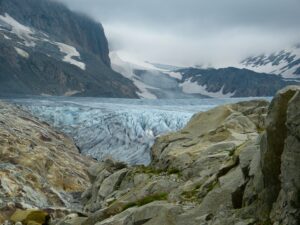
Le rapport souligne également que les impacts à court terme dans les zones de montagne sont inévitables. Compte tenu des politiques actuelles de réduction des gaz à effet de serre, il est probable que le réchauffement de la planète dépassera 1,5°C au cours du XXIe siècle et qu’il sera difficile de le maintenir en dessous de 2°C. Les principaux dangers et risques associés attendus à court terme avec un réchauffement mondial de 1,5°C sont les changements liés à la cryosphère qui influencent les inondations, les glissements de terrain et la disponibilité de l’eau, avec de graves conséquences pour les populations, les infrastructures et les économies dans la plupart des régions montagneuses.

Avec 1,5 °C de plus, le GIEC prévoit également une augmentation des incendies de forêt, une mortalité importante des arbres, l’assèchement des tourbières, le dégel du pergélisol et l’affaiblissement des puits de carbone terrestres naturels. Ces impacts ont également un effet boule de neige, car ces événements peuvent augmenter la libération des émissions de gaz à effet de serre stockées, par exemple, dans les forêts et les tourbières, ce qui rendrait les inversions de température plus difficiles.

Le rapport du GIEC montre une nouvelle fois qu’il est urgent d’atténuer le changement climatique afin d’éviter des conséquences plus graves pour les écosystèmes et les populations locales des montagnes (conséquences d’autant plus préoccupantes que les montagnes fournissent des services écosystémiques au-delà de leurs frontières, notamment en matière d’approvisionnement en eau).

Le rapport souligne également la nécessité d’introduire des mesures d’adaptation dans les zones déjà gravement touchées par le changement climatique. Toutefois, le rapport du GIEC souligne que les limites de l’adaptation douce et dure ont déjà été atteintes dans certains secteurs et régions, en particulier dans les zones montagneuses. Le sixième rapport d’évaluation du GIEC « Changements Climatiques 2022 : Impacts, Adaptation et Vulnérabilité », a révélé que la plupart des mesures d’adaptation prises dans les montagnes concernaient principalement l’agriculture et le tourisme, et peu d’autres secteurs. Le rapport, qui comprend un chapitre entier sur les montagnes dirigé par Carolina Adler (chercheuse au MRI, membre de NEMOR), souligne que parmi toutes les mesures d’adaptation signalées, 91 % impliquent des individus ou des ménages, souvent engagés dans l’agriculture paysanne et/ou le pastoralisme. Les gouvernements locaux sont impliqués dans 31 % des cas et les acteurs de la société civile régionale ou locale dans 29 % des actions recensées, tandis que le secteur privé n’est impliqué que dans 10 % des cas.

Share
30 mars 2023

Euromontana sur Facebook

6 days ago

Euromontana
❄️ Winter may seem to have arrived, but climate change is shortening the season and making snowfall less reliable...leaving mountain resorts with a stark choice: close or adapt?⛰️ Head to Austria to discover how the Sankt Corona ski resort has responded to this challenge and turned a climate risk into a regional asset, as part of the Interreg Alpine Space - TranStat project: www.euromontana.org/sankt-coronas-response-to-climate-change-diversifying-tourism-for-a-resilient...👉 Explore our good practices database: www.euromontana.org/good-practices-database/ Photo credits © Wexl Arena St. Corona am Wechsel ... See MoreSee Less
View on Facebook

4 weeks ago

Euromontana
🎄𝗘𝘂𝗿𝗼𝗺𝗼𝗻𝘁𝗮𝗻𝗮 𝘄𝗶𝘀𝗵𝗲𝘀 𝘆𝗼𝘂 𝗺𝗼𝘂𝗻𝘁𝗮𝗶𝗻𝒔 𝗼𝗳 𝗵𝗮𝗽𝗽𝗶𝗻𝗲𝘀𝘀 𝗳𝗼𝗿 𝟮𝟬𝟮𝟲🎅 After a year full of events, encounters, political challenges and new collaborations, it is time for the secretariat to take a short break. We will meet again soon in 2026 to continue our actions and make the voice of mountain areas heard by the EU! 🏔️ But in the meantime, let's take a step back and look at the year 2025 before it comes to an end!This year, together we: 📃 celebrated the 30th anniversary of the Krakow Declaration, which paved the way for the creation of our network, and renewed our commitment to mountain areas 🔗 www.euromontana.org/thirty-years-on-calling-for-a-stronger-european-commitments-to-its-mountains/ 🤝 launched an Alliance for European Mountains, between elected representatives of the European Committee of the Regions and the European Parliament 🔗https://www.euromontana.org/press-release-alliance-for-european-mountains-launched-mountains-need-europe-and-europe-needs-mountains/ 👩‍🏫 collaborated on more than seven European research projects with our members and other partners all over Europe🧊 highlighted water-related challenges during this International Year of Glacier Preservation (hashtag#IYGP2025)🔗 www.euromontana.org/european-manifesto-for-a-governance-of-glaciers-and-connected-resources/👋 welcomed new members, including from Montenegro and Italy🌱 visited initiatives across Europe promoting resilience in our mountain territories, through research projects or by hosting our board of directors in Trento (Cooperazione Trentina) and Krakow (Małopolska)• and much more!Thank you to all our partners, members and friends of Euromontana for this wonderful year! ... See MoreSee Less
View on Facebook

4 weeks ago

Euromontana
⏮️ Last week, on 11 December, we celebrated International Mountain Day, established in 2002 by the United Nations to remind us of the role mountains play in many aspects of sustainable living 🌱 On this occasion, we were featured in an article by the Food and Agriculture Organization of the United Nations (FAO) Liaison Office with the European Union alongside other EU regions, sharing our vision of what mountains mean to their people, cultures, and economies 🏔️ 🗣️ Our "voices form a vivid mosaic—a portrait of landscapes that shape identity, heritage, and sustainable futures."Have a look 👉https://www.fao.org/brussels/news/news-detail/international-mountain-day--voices-from-the-peaks/en ... See MoreSee Less
View on Facebook

4 weeks ago

Euromontana
👩‍🌾 We are currently attending the EU Agri-Food Days, organised by the European Commission and DG AGRI, which are taking place in Brussels over the course of three days!We heard from the president of the European Commission Ursula von der Leyen and the European Commissioner for Food and Agriculture, Christophe Hansen, and attended numerous high-level political sessions with stakeholders in the sector 🗣️ The agenda included discussions on achieving a robust and contemporary CAP to ensure food security across the EU, establishing fair remuneration schemes within the food chain, and fostering a resilient agri-food sector 👩‍🌾 🌱 Euromontana will continue to play an active role in promoting a future CAP that benefits those most in need and supports the territorial development of rural areas in the face of climate change and generational renewal challenges 🏔️ 👉 Read our policy position on generational renewal within the CAP and our other contributions to the next European budget: www.euromontana.org/meeting-the-challenges-of-generational-renewal-shaping-the-future-of-mountain... EU Food & Farming ... See MoreSee Less
View on Facebook

1 month ago

Euromontana
🧊 Glaciers matter for water, food and livelihoods in mountains and beyond. This is what we are highlighting this year on 11 December, International Mountain Day.Every year, this day provides an opportunity to emphasise the crucial importance of these areas in terms of natural resources, biodiversity, identity, cultural heritage, ways of life, and more resilient models. However, all of this is under threat from climate change, poorly targeted funding and negative perceptions of pastoral professions.Today, we are putting the spotlight on these endangered ice giants throughout our mountain ranges!Did you know that: 💧The Alps alone provide 40% of Europe's fresh water?💡Glacier retreat will reduce hydroelectric energy production by an average of 10% in the Alps and by up to 35% by 2070 compared to today?🌱68% of irrigated agricultural land in the plains depends directly on water runoff from the mountains? ⛰️By 2034 the Pyrenees will be ice-free?📢An appropriate governance of glacier is needed to counteract the rapid changes!🧊 By signing the manifesto for better European governance of glaciers alongside 80 other organisations, we are calling for immediate and targeted political responses to the economic, social and environmental impacts of climate change.Have a look 👉 www.euromontana.org/european-manifesto-for-a-governance-of-glaciers-and-connected-resources/ #IMD2025 #InternationalMountainDay #MountainsMatterMountain Partnership ... See MoreSee Less
View on Facebook

Euromontana sur Twitter