



 The Intergovernmental Panel on Climate Change (IPCC) has published the Synthesis Report of the IPCC 6th Assessment Report. It summarises the state of knowledge on climate change, its widespread impacts and risks, and on mitigation and adaptation. Here are the key takeaways regarding mountain areas.
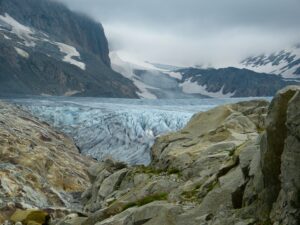
The first key message of the new IPCC report is that the extent and magnitude of climate change impacts are greater than estimated in previous assessments. In this regard, the IPCC notes that some impacts of climate change are already almost irreversible, such as the effects of hydrological changes due to glacier retreat or changes in some mountain ecosystems.
The report also stresses that short-term impacts in mountain areas are inevitable. Given current policies to reduce greenhouse gases, it is likely that global warming will exceed 1.5°C during the 21st century and that it will be difficult to keep it below 2°C. The main hazards and associated risks expected in the near term with global warming of 1.5°C are cryosphere-related changes affecting floods, landslides, and water availability, with serious consequences for people, infrastructure and economies in most mountain regions.
With an additional 1.5°C, the IPCC also predicts increased forest fires, massive tree mortality, drying of peatlands, thawing of permafrost and weakening of natural terrestrial carbon sinks. These impacts also have a snowball effect, as these events can increase the release of greenhouse gas emissions stored, for example, in forests and peatlands, which would make temperature inversions more difficult.
The IPCC report therefore once more demonstrates the urgency of mitigating climate change in order to avoid more severe impacts on local mountain ecosystems and populations (impacts that go beyond their borders given the ecosystem services provided by mountains, in particular water supply).
The report also points to the need to introduce adaptation measures in areas already severely affected by climate change. However, the IPCC report stresses that the limits of soft and hard adaptation have already been reached in some sectors and regions, particularly in mountain areas. The IPCC’s Sixth Assessment Report, Climate Change 2022: Impacts, Adaptation and Vulnerability, found that most of the adaptation measures taken in the mountains were mainly related to agriculture and tourism, and little to other sectors. The report, which included an entire cross-chapter on the mountains led by Carolina Adler (MRI researcher, member of NEMOR), highlights that among all the reported adaptation actions, 91% involve individuals or households, frequently engaged in smallholder agriculture and/or pastoralism. Local governments are involved in 31% of the cases and sub-national or local civil society actors in 29% of the reported actions, while only 10% involve the private sector.
30 March 2023


