



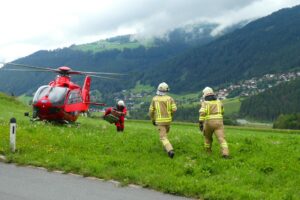
 Nearly 900,000 hectares of land burnt in 2022, according to the recent Joint Research Centre report on Forest Fires in Europe, Middle East and North Africa 2022. This is a significant increase compared to 2021, when 500 500 hectares of land burnt, and makes 2022 the second worst year after 2017, when 1.3 million hectares of land burnt. The European Union also broke a sad record in 2022, with the largest fire ever recorded in the EU in Alexandroupolis (Greece), with 96,000 hectares burnt.
France, Italy, Spain, Portugal and Croatia are among the countries most affected by forest fires in 2022.
Fires in mountain areas
Of the 900 000 hectares burnt in 2022, about 365 000 hectares belong to Natura 2000 sites. Mountain areas are biodiversity hotspots and are home to a large proportion of these protected areas, around 43% in the European Union. In 2022, Natura 2000 sites in Romania, Spain, Portugal and France were particularly affected by forest fires. In addition, the JRC report notes that the total area burnt in Natura 2000 sites in 2022 is the highest in a decade, which is an alarming sign for biodiversity.
While the report points out that 96% of fires are human induced, it also stresses that they are being exacerbated by climate change. In south-eastern France, for example, 2022 was characterised by a marked precocity; numerous fires occurred in the mountains in January and February, well above the seasonal average, due to the lack of snow cover.
The EU wants to put out the fire
These alarming figures underline the urgent need to combat forest fires in the coming years in order to better protect mountain populations and ecosystems. As the JRC points out in its report, the 2022 record is only a glimpse of what could become more serious in the future as a result of rising temperatures and more frequent droughts.
In view of the growing fire risk, the European Union intends to strengthen its fire prevention capacity. At the request of the Member States, the European Commission presented a Wildfire Prevention Action Plan in October 2022. It aims to increase knowledge, funding and capacity to respond to forest fires. The EU is also in the process of establishing a forest monitoring framework, which should include a fire component.
To improve its fire-fighting capacity, the EU is also relying on research and innovation progress through projects such as FIRE-RES. This Horizon2020 project aims to develop a pan-European integrated approach to fire management, addressing all phases of fire: prevention and preparedness, detection and response, and adaptation and rehabilitation. To achieve this, the project is testing innovations in 11 Living Labs, including in the region of Nouvelle Aquitaine (France), where, according to the JRC, the Landiras fire in 2022 was the second largest fire recorded in France in the last fifty years.
14 December 2023


