



The Intergovernmental Panel on Climate Change (IPCC) predicts that global warming will reach between 1.5°C and 2°C during the 21st century compared to the pre-industrial era. Mountain areas are among the first to be affected by climate change and the IPCC stresses that the current adaptation efforts are insufficient to address future risks in mountain areas.
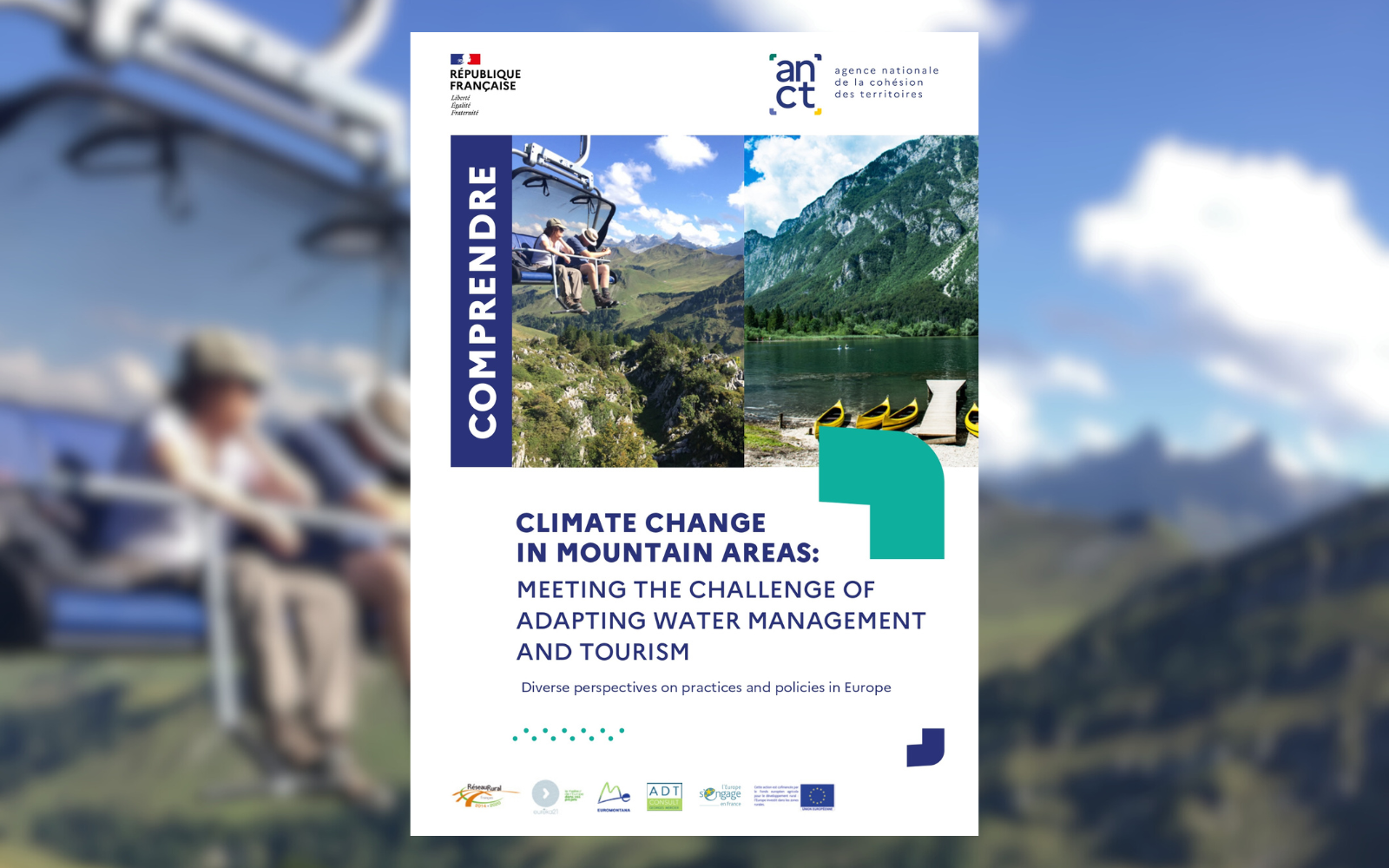
In this context, Euromontana, together with Eureka 21 and ADTconsult, has carried out for the French National Agency for Territorial Cohesion (Agence Nationale de la Cohésion des Territoires) the study “Climate change in mountain areas: meeting the challenge of adapting water management and tourism – diverse perspectives on practices and policies in Europe”. Focusing on the challenges of adaptation in water and tourism management in mountain areas, this study analyses the policies and practices implemented in 5 European mountain countries – Austria, Spain, Italy, Romania and Slovenia – and draws a comparison with the French case.
Action gaps in climate change adaptation
Based on a comparative analysis and interviews with mountain stakeholders, the study presents the state of play of climate change adaptation policies in water and tourism management in mountain areas.
The study highlights the uneven level of awareness of the expected impacts of global warming in mountain areas. It found that mountain stakeholders are well informed and aware of the need to adapt tourism practices, but much less so when it comes to water management.
Adaptation in the tourism sector remains fragile, with 53% of Europe’s 2,234 ski resorts facing critical operational risks without snowmaking and with a 2°C rise in temperature. This figure rises to 98% with a 4°C temperature rise. In addition, many of the investments made are at risk of maladaptation, particularly when it comes to winter tourism. Yet there is a clear increase in awareness among industry players, and initiatives to decarbonise mountain tourism and steer resorts towards a 4-season model are multiplying.
With regard to water management, the study concludes that there is a general lack of awareness of the urgent need for adaptation policies in the mountains. Some practices are worth mentioning, such as the PIRAGUA project, which has allowed an assessment of water resources in the Pyrenees until 2050, or the Romanian Mountain Law, which regulates water use and gives priority to the needs of wild ecosystems and livestock over hydroelectric plants. Nevertheless, there is a clear lack of data and awareness of water issues in the different countries studied, despite the fact that the resource is crucial for both mountain and lowland communities.
Approaches for a better and faster adaptation to climate change in mountain areas
Based on the comparative analysis, the study provides recommendations to the different stakeholders in mountain areas and to policy makers at all levels:
- Improve knowledge about climate change in mountain areas and raise awareness among stakeholders, decision-makers and the general public about the challenges of adapting to climate change in mountain areas.
- Promote a shift in the tourism model by diversifying both the range of tourist services and the economic activities available in the same area in order to increase the resilience of mountain areas to climate change.
- Involve stakeholders and citizens in adaptation strategies to promote understanding and acceptance of the environmental transition.
- Establish local, regional (as in Catalonia), national (as in France and Romania) and European policies specific to the needs and challenges of mountain areas in order to better adapt to climate change.
- Earmark funding for mountain areas at European and national level, drawing inspiration from existing initiatives such as the Avenir Montagnes programme (France), which should be scaled up and extended to cover more sectors.
- Support capacity building and engineering in mountain areas to enable all territories, including smaller municipalities, to implement and finance climate change adaptation strategies.
The study is available in French and English here, along with an executive summary for decision-makers.
Interested in learning more about how your mountain region can adapt to climate change? As part of the MountResilience project, Euromontana will develop a community of practice on climate change adaptation in mountain areas. The learning programme of this community will be developed from the identification of the needs and good practices of mountain actors. A call for expression of interest should be launched in 2024 by Euromontana to join the Community of Practice. If you have questions about this community, please contact Marie Laurent, EU Projects Officer, at marie.laurent[a]euromontana.org.
5 February 2024


