



Date / Heure
Date(s) - 14 Mar 2019
14 h 30 min - 18 h 30 min
Emplacement
EESC - Brussels Belgium
Content
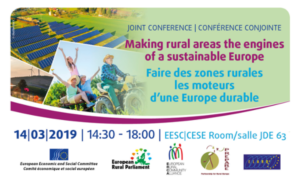 Joint European Economic and Social Committee (EESC)/ European Rural Parliament (ERP) Conference on making rural areas the engines of a sustainable Europe.
The ERP and the EESC are both concerned about the future of rural areas, which policy-makers and politicians generally tend to neglect. In their own way, both do their utmost to enliven rural areas so that people want to live and work in them.
Both the EESC and the ERP have urged the EU to come up with actions in support of rural areas, in an effort to steer policy in the direction set out in the Cork 2.0 Declaration. The EESC’s Section for Agriculture, Rural Development and the Environment and the European Rural Parliament plan to organise a joint, web-streamed event on 14 March 2019 on EESC premises. The topic of discussion will be how, in the light of upcoming policy changes (The Reflection Paper “Towards a Sustainable Europe by 2030”, Common Agricultural Policy, Multiannual Financial Framework, etc.), to better integrate the aspect of the future of Europe’s rural areas into the policies of the next European Commission and European Parliament with the aim to promote a more Sustainable Europe.
Agenda
Speakers remain to be confirmed
- 14.30 – 15.00│Introduction
-Mr. Luca Jahier, President of the European Economic and Social Committee
-Mr. Staffan Nilsson, President of European Rural Community Alliance (ERCA), Co-Chair of the ERP Steering Group│Presentation of the Reflection Paper
-Ms. Céline Gauer, Deputy Secretary-General, Secretariat-General, European Commission
- 15.00 – 16.15│An urgent call for action to new, incoming legislators to step up the role of rural areas in a sustainable Europe
Moderator: Mr. Tom Jones, EESC Rapporteur on Rural Development
-Mr. Goran Šoster, Vice-President of Partnership for Rural Europe (PREPARE), Co-Chair of the ERP Steering Group
-Ms. Maria João Botelho, President of the European LEADER Association for Rural Development (ELARD)
-Mr. Gérard Peltre, President, Rurality-Environment-Development (R.E.D.) / European Countryside Movement (M.E.R.)
-Mr. Eamon O’Hara, Executive Director, European Network for Community-led Initiatives on Climate change and Sustainability (Ecolise)
-Mr. Juan-Andres Gutierrez, President, European association for mountain areas (Euromontana) - Discussion
- 16.15 – 16.30│Coffee break
- 16.30 – 17.45 | Stocktaking of current situation of rural development policy: Assessing accomplishments since Cork 2.0, evaluating prospects post-2020
Moderator: Mr. Maurizio Reale, NAT Section President
-Mr. Czesław Siekierski, Chair of the Committee on Agriculture and Rural Development, European Parliament
-Mr. Achim Irimescu, Head of Unit – Agriculture, Fisheries and Rural Development, Romanian Presidency of the Council of the EU
-Mr. Martin Scheele, Director (acting), DG AGRI, European Commission
-Mr. Guillaume Cros, CoR Rapporteur on the CAP after 2020, Vice-President of the Regional Council of Occitanie (France)
-Mr. Paul Soto, Senior Policy Expert at the Contact Point of the European Network for Rural Development - Discussion
- 17.45 – 18.00 | Closing remarks
-Mr. Petri Rinne, European Rural Parliament and President of the Finnish Village Movement Association
-Ms. Maria Nikolopoulou, NAT Section Vice-President, EESC
Contact
More information on the EESC website. For any questions, please email nat-events@eesc.europa.eu


