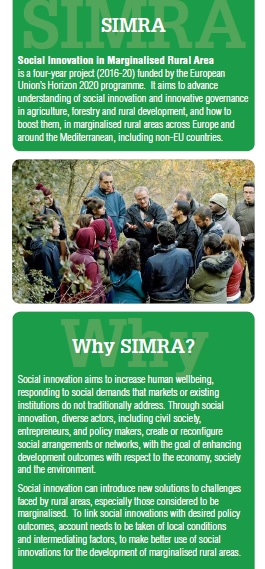
 Social Innovation in Marginalised Rural Areas (SIMRA) is a project funded by the European Union’s Horizon 2020 research and innovation programme. SIMRA seeks to advance understanding of social innovation and innovative governance in agriculture, forestry and rural development, and how to boost them, particularly in marginalised rural areas across Europe, with a focus on the Mediterranean region (including non-EU) where there is limited evidence of outcomes and supporting conditions.
This Horizon 2020 project, coordinated by the James Hutton Institute, started on the 1st April 2016 for four years and ended in March 2020.
The partnership consists of 26 partners in Europe and in the Mediterranean Region. Four members of Euromontana participate: UHI Perth, ENRI, EURAC and SAB. Andreja Borec from Maribor University is part of the project’s Social Innovation Think Tank (advisory body). Euromontana is the co-leader of the Work Package on Communication and Dissemination.
 To find more on SIMRA, you can also:
- Visit SIMRA’s website
- Follow SIMRA on Twitter @simra_eu
- Follow SIMRA on Facebook @SIMRAeu
- Or on Scoop it!
- And on ResearchGate
Rationale
According to SIMRA, social innovation refers to “the reconfiguring of social practices, in response to societal challenges, which seeks to enhance outcomes on societal well-being and necessarily includes the engagement of civil society actors”. Re-inventing the role of actors, their interactions and their capacity to innovation, social innovation nurture the hope to overcome challenges such as ageing populations, outmigration or climate change. It is essential to consider local conditions and various intermediate factors to use social innovations for the development of marginalised rural areas.
If you wish to know more how social innovation occurs in practice, give a look at our collection of examples and online database of social innovation actions.
Key results
Social Innovation: A Practice Guide: 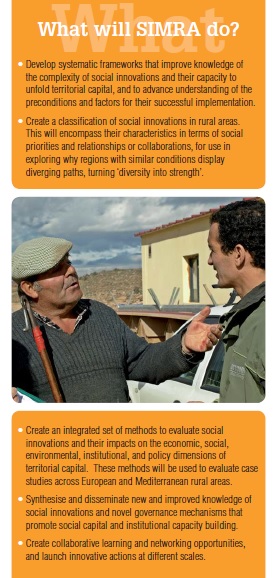 A 100% hands-on publication to guide you, as actors on the ground, through the 7 crucial steps to design, develop and implement your social innovation in marginalised rural areas and beyond. Also available in FR, ES, IT and SR.
Policy Brief “How Policy Can Help bring about social Innovation in Rural Areas?” : to guide you, policy-makers from regional, national and European authorities to support the creation of an enabling environment with which social innovations can flourish. Also available in: FR, ES, IT, SR and AR.
MOOC on Social Innovation in Rural Areas: that will run for 3 weeks from 30th March 2020 and be freely available for one year on the FutureLearn platform, to steer researchers, students and practitioners across the landmarks of social innovation.
Database of social innovations: An interactive map to drive you, social innovator, practitioner and research, through more than 300 examples of social innovations in agriculture, forestry and rural developed in marginalised rural areas can be accessed.
7 Innovation Actions: to showcase you, actors on the ground, researchers and local authorities, on how to design and implement a social innovation action levering on collaborative learning, inspired discussion and cross-actors collaboration.
6 Brochures of good practices: to inspire you, actors on the ground, researcher and authority, with real examples of social innovations in forestry, agriculture and rural development:
- Forest management
- Social Innovation in Mountain areas
- Social innovation in the Balkans
- Rural services
- Social innovation in the Mediterranean and in Europe
- Social innovation and the Green Deal
Evaluation of Social Innovation: to provide you, evaluator, researcher, policy and decision makers, frameworks, approaches and methods to assess (qualitatively and quantitatively) the impacts of social innovation.
Evaluation Manual to help you, evaluators, practitioners, policy makers and scientists, in assessing the impacts of social innovation on the economy, society, environment and institutions.
Highlights from the final conference: held in Brussels (February 2020), the key points of SIMRA’s closing event will give you an overview on how social innovation can advance state-of-the-art.
Project Impacts
SIMRA contributed to advance understanding on how social innovation might contribute to the development of marginalised and rural areas. Based on this theoretical and evaluative framework, the project developed empirical analyses and pilot actions to operationalise social innovation in several domains (agriculture, forestry and rural development) and countries (EU and not EU). This provided a comprehensive mapping on the diversity of social innovation measures, in terms of governance, business models, objectives, forms of supports etc. Key findings served to create several transferable tools for practitioners, social innovators, scientists, policy and decision makers (see Key results). SIMRA’s impact was enhanced through its co-constructed, multi-actor approach in particular by involving SMEs, entrepreneurs, and social enterprises, networks and partnerships in the project.