

• fr
  • en

How will work evolve in remote areas?

On Friday 27th May, in the premises of the Cultural Center Skrad,the new project of the Local Development Agency PINS “Go Remote” was presented. Montana174 participates to the event.

COVID-19 impact on youth and employment in remote areas

During the year 2020, COVID-19 crisis affected employment in two significant ways. On the one hand, unemployment rose sharply and the most significant percentage increase was recorded across young generations. On the other hand, teleworking has become the new norm. The merging of these two effects resulted in the “Go remote” project. On 27th May, this project was presented by Ms. Dubravka Kolarić Zatezalo, President of the Board of the Local Development Agency PINS.

Go Remote reduces youth employment
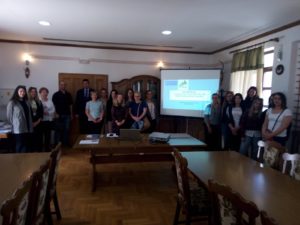
“Go Remote” aims to reduce youth unemployment in rural areas by educating people between 20 and 29 years old to work remotely. In particular, this project seeks to increase the quality and number of remote job opportunities, making remote jobs available not only to the upper class, but also to those most in need – young people from less developed areas, facing demographic, social and economic barriers.

To achieve this, “Go Remote” will help to identify the profiles of remote workers across different countries (Bulgaria, Croatia, Cyprus and Latvia) and the most appropriate skills to do these jobs. Therefore, the project will define the most appropriate methods and approaches for training NEET youth on these skills.

The project was supported by the  Head of the Unified Administrative Department of the Municipality of Skrad, Mr. Marko Moguš, head coach of the Go Remote project, Mr. Milan Vukelić, representative of the Ministry of Science and Education and young entrepreneurs Antonija Podobnik and Lana Renka.

More ways to support youth and employment in remote areas

At the end of event, Ms. Josipa Liker from the Local Development Agency PINS presented the outputs of Montana174 to youth and employment, such as the video testimonials and some examples of projects funded by Cohesion Policy to support youth and job opportunities in mountain areas. She also introduced the participants to the new financial perspective 2021-2027 and the many opportunities it offers.

Share

Euromontana sur Facebook

1 week ago

Euromontana
Today, Euromontana had the pleasure to take part in the journalist training course “Transizione ecologica nelle aree montane: biodiversità, cambiamento climatico e sviluppo sostenibile”, organised by Università della Montagna with the Ordine dei Giornalisti della Lombardia (the Lombardy Association of Journalists 📰)The course, bringing together 65+ participants, focused on how to better understand and report on ecological transition in mountain areas, from biodiversity and climate change to sustainable development ⛰️👉This matters because the way mountain areas are reported shapes the way they are understood and, ultimately, the way they are governed!We were pleased to join our member UNIMONT in this exchange. Prof. Anna Giorgi highlighted the need to change the way mountain areas are perceived, beyond fragility and marginality. Stefano Sala then showed how issues such as depopulation, winter tourism, climate change and public policy require a more nuanced reading of mountain realities 🔍 For Euromontana, Guillaume Corradino brought a European perspective to the discussion. He stressed that :1️⃣ mountains are not Europe’s margins, but diverse and complex living territories, and 2️⃣ stronger place-based policies and European cooperation are needed to move from recognition to implementation.Thanks again for the organization, the opportunity, and to all the participants 👏 ... See MoreSee Less
View on Facebook

3 weeks ago

Euromontana
⌛ Only a few days left to benefit from the early bird prices for the 2026 XIV #europeanmountainconvention (Sallanches, 30 June - 2 July) ! We’re already eagerly awaiting your visit to discuss the future of extensive livestock farming in mountain areas! 🌄Through plenary sessions, high-level panels, interactive workshops and field visits, the Convention aims to address the following topics:· Demographic renewal in agriculture, including pastoral schools· Shared land use and access to grazing land· The contribution of extensive livestock farming to risk prevention and adaptation to climate change· The role for digital innovation in a changing world· The living and working conditions· and more 👀 Registration, programme, and practical information 👇www.mountainconvention.eu #IYRP2026 #internationalyearofrangelandsandpastoralists Afficher la traduction ... See MoreSee Less
View on Facebook

Euromontana sur Twitter