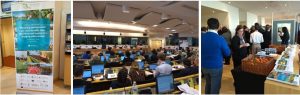
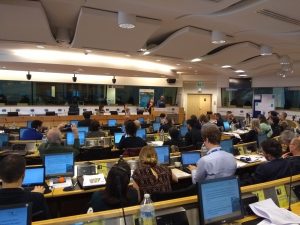
 On 7 February 2018, more than 120 people representing national authorities, EU institutions, the agricultural and forestry sectors, academics as well as NGOs and think tanks gathered in Brussels to contribute to an evolving policy debate in Europe through discussions around the key lessons and messages of the PEGASUS project.
The final conference of PEGASUS took the participants through a summary of the results of over 3 years of research on concrete ways to enhance the provision of environmental and social benefits by agriculture and forestry, and what this means for policy and practice in Europe.
The Pegasus key policy recommendations of the project are:
- There is a need for a step change in policy to deliver more environmental and social benefits with a new approach which should bring people to the centre stage.
- Policies need to promote cooperative ways of working (i.e. through more multi-actor groups, or ‘collective’ action) to increase engagement and commitment of farmers and foresters.
- Institutions need to build trust and embed dialogue with stakeholders at all stages of the policy cycle.
- Allow for a more flexible and joined up use of the policy mix, better adapted to local needs.
- Mainstream the combined use of facilitation and capacity building with other measures so that it becomes the norm rather than the exception.
The feedback received at the Final Conference from the range of participants has been encouragingly positive.
 Setting the scene, Tassos Haniotis, Head of Strategy and Policy Analysis at DG AGRI, recognised the key role of having sufficiently capable and effective Farm Advisory Systems in the Member States, to ensure notably better results.
Discussants at the event, Frank Jésus from the OECD and Andrea Vettori from DG ENV highlighted the potential of the mapping exercise carried out and the importance of social processes and local communities in the way policies are implemented. The project’s focus on “collective” action perhaps received more mixed feedback with some arguing that it may be difficult to truly mainstream its use in all policy areas or in all contexts – which the project team corroborates.
Later on during the panel discussion, the speakers overall expressed their support to the lessons in PEGASUS, relating these to their different experiences and areas of expertise. For example, Martijn Buijsse, Policy Officer at the European Initiative for Sustainable Development in Agriculture recognised that “social capital is an asset which can have real economic value, in terms of reducing transaction costs”.
Through a range of case studies, the Conference highlighted how these lessons would be of particular relevance if the CAP post-2020 is to evolve towards a new delivery approach based on performance and results. “A big challenge to overcome is the inertia that there exist in institutions, especially at the national and regional levels, partly due to fear of control failure”, said James Moran, Lecturer from the Galway-Mayo Institute of Technology.
“We are pleased to see that the project findings found real resonance with the participants present today”, said Anne Maréchal, Project Manager at IEEP. “Key messages from the day include the need to increase engagement with actors on the ground, to be working together more and how institutional settings, more flexible policy tools and an increased support to facilitators are critical to this outcome.”
To read more about the key findings and messages of the PEGASUS project, find the briefings on the project’s key messages here