



The European Commission published on June 17, 2020, its Report on the Impact of Demographic Change in the EU. Coordinated by Dubravka Šuica, European Commissioner for Democracy and Demography, this report outlines the main challenges of demographic change and maps the future evolutions.
Rural population is shrinking
In its report, the European Commission identifies the challenges linked to demographic change for European regions. One of the conclusions is the transfer of population from rural to intermediate areas. While 28% of the EU population was living in rural areas back in 2015, this proportion falls to 21% in 2020. These 7 points of difference are reflected in the increase of the EU population living in intermediate areas (from 32% in 2015 to 39% in 2020), whereas urban areas’ population remained unchanged (40% of the EU population).
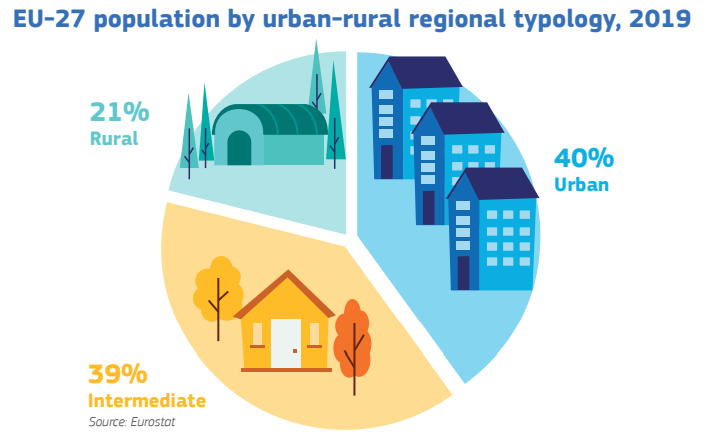
These populations’ transfers from rural to intermediate areas lead to the constant shrinkage of certain rural regions. In eight Member States, rural regions have been constantly losing population since 1991; all these rural regions are located in Bulgaria, Croatia, Hungary, Portugal and Romania and the three Baltic States. A deeper analysis of rural shrinkage has been made by the ESPON ESCAPE project, which identifies the different reasons of rural depopulation in the EU and analyses these trends at local level.
For the Commission, rural depopulation brings a main challenge for agriculture, in relation with generational renewal. Indeed, the lack of attractivity of rural areas leads not only to a lack of young farmers but also to land abandonment and increased risk of forest fires, which is typically threatening for mountain areas and pastoral economy.
Europe is ageing
The main drivers of demographic change in Europe identified in the report are linked to the longer life expectancy and decrease of birth rate which lead to a European ageing population. By 2070, 30% of people in Europe are estimated to be aged 65 and above, up from about 20% today.
Demographic forecasts bring new challenges for these ageing regions, especially in rural and mountainous areas. The European Commission’s report in particular highlights the shortage of general practioners in rural areas as well as the lack of long-term care offer for older adults. In addition, since social protection for long-term care does not exist in all Member States, contrary to healthcare protection, the report stresses the risk of further socio-economic exclusion of older generations in the future.
Rural areas need investments to boost attractiveness
It will therefore be crucial to investigate on solutions to enhance rural areas’ attractivity. This for instance includes more investments for rural digitalisation, as mentioned in the report, to bridge the gap with urban areas and create more employment and education offers. Solutions will further be explored in 2021 in the EU Long-term vision for rural areas.
The report refers also to the opportunities offered by the Silver Economy, including in rural areas, a sector which can contribute to increase the quality of life of older adults by providing innovative services. In this regard, the Interreg Europe SILVER SMEs project, in which Euromontana is involved in, is exploring possibilities for regional policies to better support SMEs of the Silver Economy sector in rural and mountainous areas and showcases more than 50 good practices in its online database. The European Commission will investigate the opportunities arising from the Silver Economy sector in the Green Paper on Ageing, expected to be published by the end of 2020.
Both issues require to reflect on solutions at local and regional level. If the European Commission stresses the importance of the NUTS3 level in its report, a real placed-based approach to tackle these issues would even require to analyse the NUTS4 and NUTS5 levels, as done by ESPON for instance.
The European Commission’s analysis of demographic trends points many challenges for rural areas. Rural depopulation combined with ageing population will require ambitious investments to attract the youth, create jobs and make rural areas vibrant while also developing adapted good and services for older generations. Euromontana therefore calls on the Commission to propose ambitious solutions in its Long-term vision and Green Paper to cope with these challenges and to consider the specificities of mountain areas, as described in our contributions sent to Commissioner Šuica (see Contribution for the Long-term vision for rural areas and Ageing in mountain areas – contribution for the Green Paper on Ageing).
23 June 2020


