



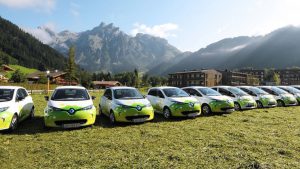
 The Alpine Pearls initiative aims to set up innovative tourism offers that respect the environment. The network currently has 25 villages (known as “Pearls”) scattered across Germany, France, Italy, Austria, Slovenia and Switzerland, six Alpine countries. The principle is to offer a total car-free mobility experience at the holiday resort, with shuttle services, hiking and ski buses, taxis, electric cars, bicycles and electric bicycles.
The origin of the project
 Founded in 2006, “Alpine Pearls” is the result of the Alps Mobility I and II, both European INTERREG IIIB Alpine Space Programme projects, that aims at running and developing a network of sustainable tourist resorts in the Alpine region. The resorts/villages that participate in the project are part of a sustainable development approach encouraging sustainable modes of transport, protection of the environment and tourism quality.
How does it work?
 All villages member of the “Alpine Pearls” network fulfill demanding quality criteria and combine their tourist offer with the pleasure of respecting the environment. Each Pearl implements environmentally friendly leisure offers, such as shuttle buses, hiking buses, ski buses, taxis, electric cars, bicycles and electric bicycles. Visitors can purchase a guest or mobility card that entitles them to use public transport for free and to help the functioning of the eco-mobility service available on site.
As a result, the city centers have little or no traffic and mobility is guaranteed by transfer services. Everything is made for visitors not to use their car.
A new form of travel contributing to the respect of the environment.
Results for the Pearls villages member of the project:
 Although it is not easy to draw statistics to determine if the tourists are attracted by the initiative or not, Pearls village see an increase in the number of new and additional tourists.
- Many Pearls villages see an increase in the number of tourists arriving due to their membership at the Alpine Pearls project;
- There is a growing number of guests using public transport and using soft mobility;
- All Pearls villages improve their offer for sustainable mobility constantly.
Results for the Alpine Pearls project:
 In ten years, the number of Pearls destinations has increased from 17 destinations in 2006 to 25 destinations in 2017. Moreover, the project has developed itself and has several positive impacts:
- The Alpine Pearls project received several prices and awards worldwide and is taken as an example, the coordinators have presented, so far, the project at more than 200 conference on sustainability worldwide;
- The Alpine Pearls organise Alpine Crossings which are long haul press trips climate neutral through the Alps. Up to 2017, the project had organised 3 Alpine Crossings gathering more than 100 journalists;
- The Alpine Pearls’ website offer 450 holiday packages online available in 4 languages;
- The project developed a project “Alpine Pearls hosts“, a network of soft-mobility-hotels which gathers 80 hotels at the moment.
For more information, please visit the Alpine Pearls website (the website is available in English, French, German, Italian and Slovenian)
3 October 2017


