



 Rezo Pouce is a solution to tackle mobility issues in rural areas. It offers a free, environmentally-friendly and user-friendly mode of transport, by promoting the practice of hitchhiking, in an organised and secure manner. Rezo Pouce was developed for local authorities that need to enrich their transport offer and intermodality with existing systems in rural areas.
1. What is Rezo Pouce?
Rezo Pouce is a mobility scheme adapted to short car rides and daily journeys in French rural and peri-urban areas. The platform was developed in partnership between a municipality, the Transdev Group, a major player in the global transport industry and the Macif Foundation, a non-profit organization dedicated to social innovation. It is now managed by a social enterprise. This French social enterprise has revisited the concept of hitch-hiking by creating a website and an app which locate the nearest registered “hitch spots”. The idea originally sparked from the closure of a train line, when daily users needed to find a solution to reach the next nearest train station.
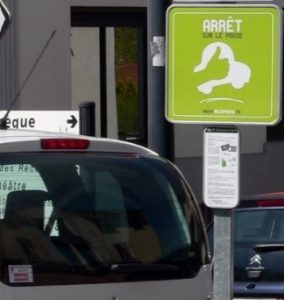 Users can get a free ride to and from their chosen destinations. The expenditure of the system (staff costs and web development mainly) is covered by the registering municipalities, with the support of LEADER in some areas. Indeed, municipalities pay a membership fee to access the Rezo Pouce services including the website, their methodology and communication services. Rezo Pouce and the municipality then work together to identify hitch-hiking stops and write up a “mobility card” for the municipality (including complementary taxi, bus and train services). The municipality is then in charge of the maintenance of the Rezo Pouce infrastructure. This business model works but required the involvement of the municipality for the maintenance of the infrastructure.
2. How to use Rezo Pouce?
Users (over 16) register with the municipality engaged in the scheme or on the website and sign the Rezo Pouce Charter to signify their agreement with the community’s values (trust, conviviality, efficiency, eco-responsibility). Drivers and passengers carry a sticker on the windscreen and have a badge. They meet at pre-defined hitch spots to share short trips between key locations. Users either do the traditional way (just go and wait at the hitch stops) or book a ride via the app.
The whole system is mainly based on trust but as a security measure, users must provide a copy of their ID card when registering on the website or in their townhall. This allows Rezo Pouce to identify any driver or passenger. Users are also given the option to send the licence plate number to Rezo Pouce if they are worried or activate their GPS device on their phones so Rezo Pouce can localise them. Trust being really at the heart of the system, this measure has just been used once.
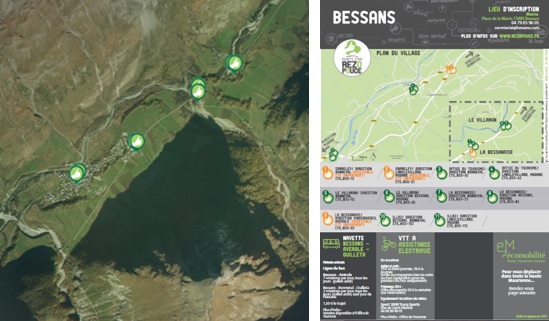
The website is designed for users to easily find a hitchhiking spot, either using an interactive map (see left image hereafter) or by downloading the specific map of one municipality (see right image). For the moment, the app is mainly used in peri-urban areas; users in rural areas still prefer using the traditional way.
3. How successful is Rezo Pouce?
A few results…
- Record waiting time is 32 seconds
- 9 times out of 10, users wait less than 10 minutes before being picked up
- Activity has grown by 300% throughout the last two years all over rural France. More than 1 500 municipalities have enrolled.
- Every week, a hundred users register on Rezo Pouce
- 75% of the trips are below 10 km and young adults with no driving license are the main beneficiaries
The aim of Rezo Pouce is truly to revisit hitch-hiking and educate people to use that mobility solution once again in a trustful and friendly atmosphere. The key element for replicability is the involvement of local authorities to communicate with their inhabitants, to identify the key hitch-hiking spots, but also to communicate with other mobility providers and develop multi-modality. There is no real competition with other service providers as they do not target the same audience.
To further extend RezoPouce, the small organisation is facing some difficulties to apply for financial support, not because of the lack of funding streams but because of the lack of staff time and difficulty of access to funding which require a strong expertise which a small organisation cannot always have.
For more suggestions on how to improve sustainable mobility in mountain areas, discover the Good Practices of the Move On Green project.
Visit their website here: https://www.rezopouce.fr/ (in French)
4 June 2018


