



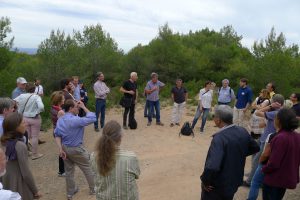
At SIMRA’s first General Assembly, celebrated in Barcelona last May at the Mediterranean European Forest Institute (EFIMED), we got the chance to see first-hand how inhabitants of the Comarca of Bages are minimizing the impact of forest fires in their area. This location was a very fitting place to learn about the efforts as two years previously, in the summer of 2015, a forest fire occurred here in the municipality of Òdena.
 But let’s start from the beginning. In the 20th Century, rural exodus and the resulting abandoning of cultivated land, led to former agricultural lands being converted into forests. Because of this increase in forested area and the resulting fires, in the 1960s, local residents and land-owners got together to create fire-fighting and immediate response groups. In 1986, these groups became official Forestry Defence Groups (called “ADF” for “Agrupacions de Defensa Forestal”). ADFs are non-for-profit organisations and their aim is to prevent and fight forest fires. They are made up of forestry land-owners, town councils from the regional municipalities as well as volunteers and they coordinate their work with the Fire and Rescue Service.
 The ADF of Castellfollit del Boix covers a total area of 5 942 hectares of which 4 397 ha are made up of forests, in other words, 79% of the total area. The forests are an important asset for the local residents; they provide a space in which to carry out various activities such as walking or mushroom picking. To protect this natural resource, the ADF has made contributions to a municipal plan for forest fires, they carry out campaigns with farmers and in schools, they safeguard water points and the mountain access tracks and they receive specialised training from the fire-fighters. When fire breaks out within the municipality, the emergency services alert the ADF and they spring into action. Often, they arrive at the fire before the fire-fighters so the first steps they take directly effects the evolution of the fire. When the fire-fighters arrive, the ADF work alongside them to tackle the fire. When a nearby municipality needs their help, the Comarca’s centre coordinates with them to help their neighbours, because forest fires do not stop at administrative borders.
 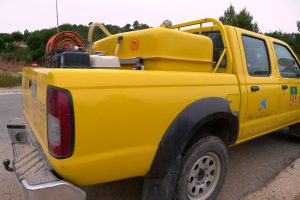 The ADF of Castellfollit del Boix is a social initiative which has allowed neighbours to come together over decades to prevent and put out fires, thereby protecting a common good: their town, landscape and forestry resources. There are two different types of members, those with a green card (16 years and older) who help out with any general tasks, but not with fire-fighting. Then there are those with a yellow card (18 years and older) who have the specific training and equipment to help, in a coordinated and safe way, with the dangerous task of putting out a fire.
 Despite their efforts, the people of Castellfollit del Boix have seen the scale of forest fires increasing each year, hile at the same time forestry practices to prevent them (clearings, scrub clearance) are becoming more and more expensive. Nevertheless, over the last decade, the use of forestry biomass to create energy has provided a way to cover the costs of forest interventions. Not only does this improve the economic sustainability of preventing fires, but it also supports the economy of this rural area. For this reason, they decided to innovate, becoming a cooperative that uses trees which are felled to prevent forest fires to make woodchips for biomass boilers. In this way, not only are they preventing forest fires and generating clean energy, but they are also creating employment and encouraging people to stay in the area.
More information
To know more about the ADF’s work, visit their website: http://www.federacioadfbages.org
Source
Article originally published on SIMRA’s website (Horizon 2020 project) and co-written by Lucía López Marco (IAMZ-CIHEAM), Elena Górriz (EFIMED) and Becky Stoakes (IAMZ-CIHEAM).
13 June 2017


