
• fr
  • en

Results of the latest Eurobarometer survey on climate change have been published!

A Eurobarometer survey was carried out in the 28 Member States of the European Union in March 2017 on the topic of climate change. This latest edition of the survey covers four main areas:

  • Perceptions of climate change (where climate change ranks alongside other global challenges, and how serious the problem of climate change itself is considered to be),
  • Taking action on climate change: who has primary responsibility for addressing the problem, and personal steps taken to help reduce greenhouse gas emissions;
  • Attitudes to fighting climate change and reducing fossil fuel imports: whether fighting climate change, reducing fossil fuel imports and promoting EU expertise in clean technologies is considered good for the economy; and whether more public financial support should be given to the transition to clean energies even if it means subsidies to fossil fuels are reduced;
  • Looking to the future: whether national governments should set targets for renewable energy, and whether they should support energy efficiency.

The report describing the results of the survey is available here and individual Member States factsheets here.

Key results of the survey include:

  • Nearly 75% of EU citizens now see climate change as a very serious problem
  • 43% consider climate change to be among the most serious problems facing the world. Respondents rank climate change as the third most serious global problem, after poverty, hunger and lack of drinking water (first) and international terrorism (second).

  • Almost eight in ten EU citizens (79%) – and a substantial majority in all Member States – believe that fighting climate change and using energy more efficiently can boost the economy and create jobs.
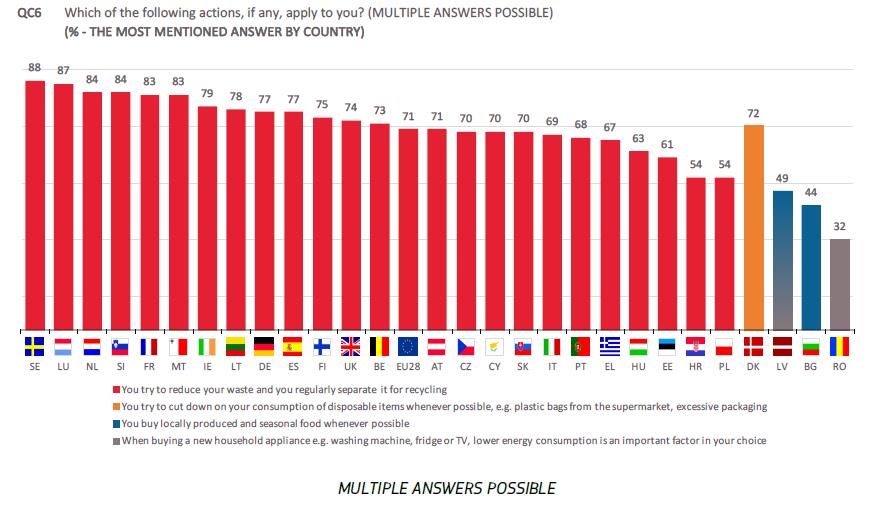
  • Roughly half of respondents say they personally take action against climate change (49%), yet when given specific examples this share rises to nine in ten (90%). The most common action is reducing waste and regularly separating it for recycling, done by over seven in ten (71%).
The EU has set itself targets for 2030, on top of targets for 2020, under a wider 2030 climate and energy package which sets three key objectives: at least a 40% cut in greenhouse gas emissions (from 1990 levels); at least a 27% share for renewable energy; and at least a 27% improvement in energy efficiency. The European Commission has also issued a ‘roadmap’ for further EU emissions cuts by 2050. Furthermore, the EU is on track to meet the targets under its 2020 climate and energy package: a 20% cut in greenhouse gas emissions (from 1990 levels); 20% of EU energy from renewables; and a 20% improvement in energy efficiency.

Europe 2020 strategy climate change & energy indicators, EU28


Europe 2020 strategy climate change & energy indicators, EU28

Past situation 2008 2015 2020 target
Greenhouse gas emissions*
(index 1990=100)

* Total emissions, including international aviation, but excluding emissions from land use, land use change and forestry.

90.31 77.88 80
Share of renewable energy in gross final energy consumption (%) 11.0 16.7 20
Primary energy consumption
(Million tonnes of oil equivalent)
1,692.4 1,529.6 1,483
Final energy consumption
(Million tonnes of oil equivalent)
1,179.7 1,082.2 1,086

Source: Eurostat

For more information about the impact of climate change in mountain areas, please find the proceedings of the X° European Mountain Convention (2016) on the theme of “Mountains’ vulnerability to climate change: how can people and territories adapt and mitigate its effects?” here.

Share
30 September 2017

Euromontana sur Facebook

4 weeks ago

Euromontana
❄️ Winter may seem to have arrived, but climate change is shortening the season and making snowfall less reliable...leaving mountain resorts with a stark choice: close or adapt?⛰️ Head to Austria to discover how the Sankt Corona ski resort has responded to this challenge and turned a climate risk into a regional asset, as part of the Interreg Alpine Space - TranStat project: www.euromontana.org/sankt-coronas-response-to-climate-change-diversifying-tourism-for-a-resilient...👉 Explore our good practices database: www.euromontana.org/good-practices-database/ Photo credits © Wexl Arena St. Corona am Wechsel ... See MoreSee Less
View on Facebook

2 months ago

Euromontana
🎄𝗘𝘂𝗿𝗼𝗺𝗼𝗻𝘁𝗮𝗻𝗮 𝘄𝗶𝘀𝗵𝗲𝘀 𝘆𝗼𝘂 𝗺𝗼𝘂𝗻𝘁𝗮𝗶𝗻𝒔 𝗼𝗳 𝗵𝗮𝗽𝗽𝗶𝗻𝗲𝘀𝘀 𝗳𝗼𝗿 𝟮𝟬𝟮𝟲🎅 After a year full of events, encounters, political challenges and new collaborations, it is time for the secretariat to take a short break. We will meet again soon in 2026 to continue our actions and make the voice of mountain areas heard by the EU! 🏔️ But in the meantime, let's take a step back and look at the year 2025 before it comes to an end!This year, together we: 📃 celebrated the 30th anniversary of the Krakow Declaration, which paved the way for the creation of our network, and renewed our commitment to mountain areas 🔗 www.euromontana.org/thirty-years-on-calling-for-a-stronger-european-commitments-to-its-mountains/ 🤝 launched an Alliance for European Mountains, between elected representatives of the European Committee of the Regions and the European Parliament 🔗https://www.euromontana.org/press-release-alliance-for-european-mountains-launched-mountains-need-europe-and-europe-needs-mountains/ 👩‍🏫 collaborated on more than seven European research projects with our members and other partners all over Europe🧊 highlighted water-related challenges during this International Year of Glacier Preservation (hashtag#IYGP2025)🔗 www.euromontana.org/european-manifesto-for-a-governance-of-glaciers-and-connected-resources/👋 welcomed new members, including from Montenegro and Italy🌱 visited initiatives across Europe promoting resilience in our mountain territories, through research projects or by hosting our board of directors in Trento (Cooperazione Trentina) and Krakow (Małopolska)• and much more!Thank you to all our partners, members and friends of Euromontana for this wonderful year! ... See MoreSee Less
View on Facebook

2 months ago

Euromontana
⏮️ Last week, on 11 December, we celebrated International Mountain Day, established in 2002 by the United Nations to remind us of the role mountains play in many aspects of sustainable living 🌱 On this occasion, we were featured in an article by the Food and Agriculture Organization of the United Nations (FAO) Liaison Office with the European Union alongside other EU regions, sharing our vision of what mountains mean to their people, cultures, and economies 🏔️ 🗣️ Our "voices form a vivid mosaic—a portrait of landscapes that shape identity, heritage, and sustainable futures."Have a look 👉https://www.fao.org/brussels/news/news-detail/international-mountain-day--voices-from-the-peaks/en ... See MoreSee Less
View on Facebook

2 months ago

Euromontana
👩‍🌾 We are currently attending the EU Agri-Food Days, organised by the European Commission and DG AGRI, which are taking place in Brussels over the course of three days!We heard from the president of the European Commission Ursula von der Leyen and the European Commissioner for Food and Agriculture, Christophe Hansen, and attended numerous high-level political sessions with stakeholders in the sector 🗣️ The agenda included discussions on achieving a robust and contemporary CAP to ensure food security across the EU, establishing fair remuneration schemes within the food chain, and fostering a resilient agri-food sector 👩‍🌾 🌱 Euromontana will continue to play an active role in promoting a future CAP that benefits those most in need and supports the territorial development of rural areas in the face of climate change and generational renewal challenges 🏔️ 👉 Read our policy position on generational renewal within the CAP and our other contributions to the next European budget: www.euromontana.org/meeting-the-challenges-of-generational-renewal-shaping-the-future-of-mountain... EU Food & Farming ... See MoreSee Less
View on Facebook

Euromontana sur Twitter