



A Eurobarometer survey was carried out in the 28 Member States of the European Union in March 2017 on the topic of climate change. This latest edition of the survey covers four main areas:
- Perceptions of climate change (where climate change ranks alongside other global challenges, and how serious the problem of climate change itself is considered to be),
- Taking action on climate change: who has primary responsibility for addressing the problem, and personal steps taken to help reduce greenhouse gas emissions;
- Attitudes to fighting climate change and reducing fossil fuel imports: whether fighting climate change, reducing fossil fuel imports and promoting EU expertise in clean technologies is considered good for the economy; and whether more public financial support should be given to the transition to clean energies even if it means subsidies to fossil fuels are reduced;
- Looking to the future: whether national governments should set targets for renewable energy, and whether they should support energy efficiency.
The report describing the results of the survey is available here and individual Member States factsheets here.
Key results of the survey include:
- Nearly 75% of EU citizens now see climate change as a very serious problem
- 43% consider climate change to be among the most serious problems facing the world. Respondents rank climate change as the third most serious global problem, after poverty, hunger and lack of drinking water (first) and international terrorism (second).

- Almost eight in ten EU citizens (79%) – and a substantial majority in all Member States – believe that fighting climate change and using energy more efficiently can boost the economy and create jobs.
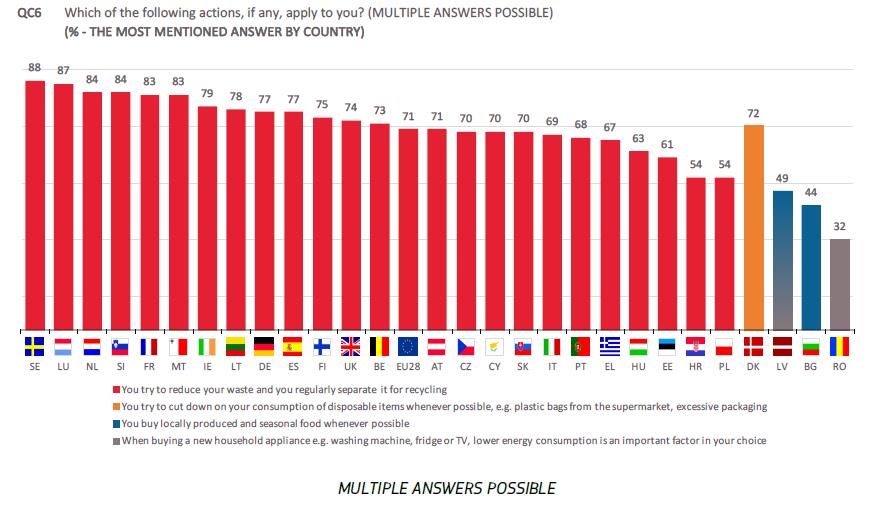
- Roughly half of respondents say they personally take action against climate change (49%), yet when given specific examples this share rises to nine in ten (90%). The most common action is reducing waste and regularly separating it for recycling, done by over seven in ten (71%).
The EU has set itself targets for 2030, on top of targets for 2020, under a wider 2030 climate and energy package which sets three key objectives: at least a 40% cut in greenhouse gas emissions (from 1990 levels); at least a 27% share for renewable energy; and at least a 27% improvement in energy efficiency. The European Commission has also issued a ‘roadmap’ for further EU emissions cuts by 2050. Furthermore, the EU is on track to meet the targets under its 2020 climate and energy package: a 20% cut in greenhouse gas emissions (from 1990 levels); 20% of EU energy from renewables; and a 20% improvement in energy efficiency.
Europe 2020 strategy climate change & energy indicators, EU28
Europe 2020 strategy climate change & energy indicators, EU28
| Past situation 2008 | 2015 | 2020 target | |
| Greenhouse gas emissions* (index 1990=100) * Total emissions, including international aviation, but excluding emissions from land use, land use change and forestry. |
90.31 | 77.88 | 80 |
| Share of renewable energy in gross final energy consumption (%) | 11.0 | 16.7 | 20 |
| Primary energy consumption (Million tonnes of oil equivalent) |
1,692.4 | 1,529.6 | 1,483 |
| Final energy consumption (Million tonnes of oil equivalent) |
1,179.7 | 1,082.2 | 1,086 |
Source: Eurostat
For more information about the impact of climate change in mountain areas, please find the proceedings of the X° European Mountain Convention (2016) on the theme of “Mountains’ vulnerability to climate change: how can people and territories adapt and mitigate its effects?” here.
30 September 2017


