



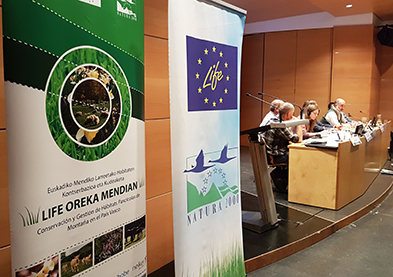
 On 26 November 2018, the LIFE project OREKA MENDIAN organised its halfway seminar in Vitoria-Gasteiz (Spanish Basque Country) on “The role of the shepherd. Tradition and technology for the conservation of mountain pastures“.
During the morning, different challenges were discussed related to the current changes in the use of mountain pastures for farming and livestock purposes, and the conservation problems derived from these, such as how to impede an increasing number of wild fires due to climate change with a decreasing number of shepherds up in the mountains?
 Different measures which exist at the European level to promote the sustainability of mountain farms, as well as concrete examples of their application, were presented by Euromontana. And the LIFE project VIVA GRASS from Lithuania was invited to present its integrated planning tool which aims to prevent loss of High Nature Value grasslands by providing models for economically viable management of grassland biodiversity to land managers and policy-makers.
Throughout the afternoon, lectures were given about the most significant progress made in the OREKA MENDIAN project, notably its SIGPASTOS database, and about the most innovative monitoring tools the project is making use of both for the conservation of grazing habitats and to support livestock activities. Some of the tools presented were demonstrated during a field visit to the Aizkorri-Aratz natural park the next day.
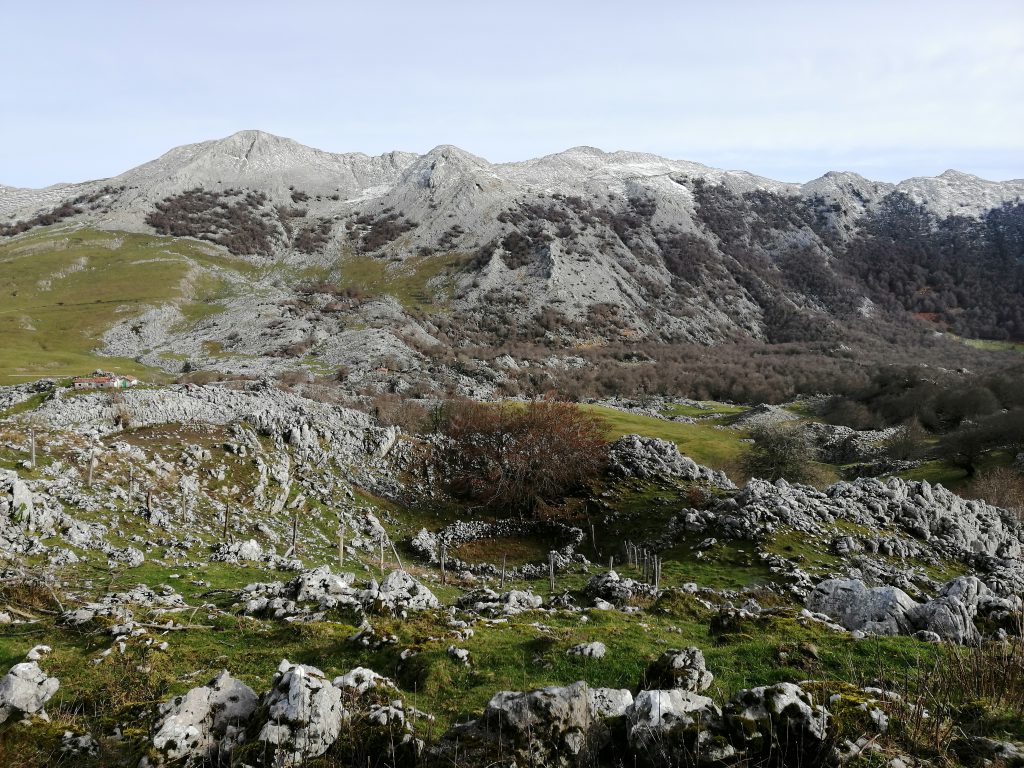
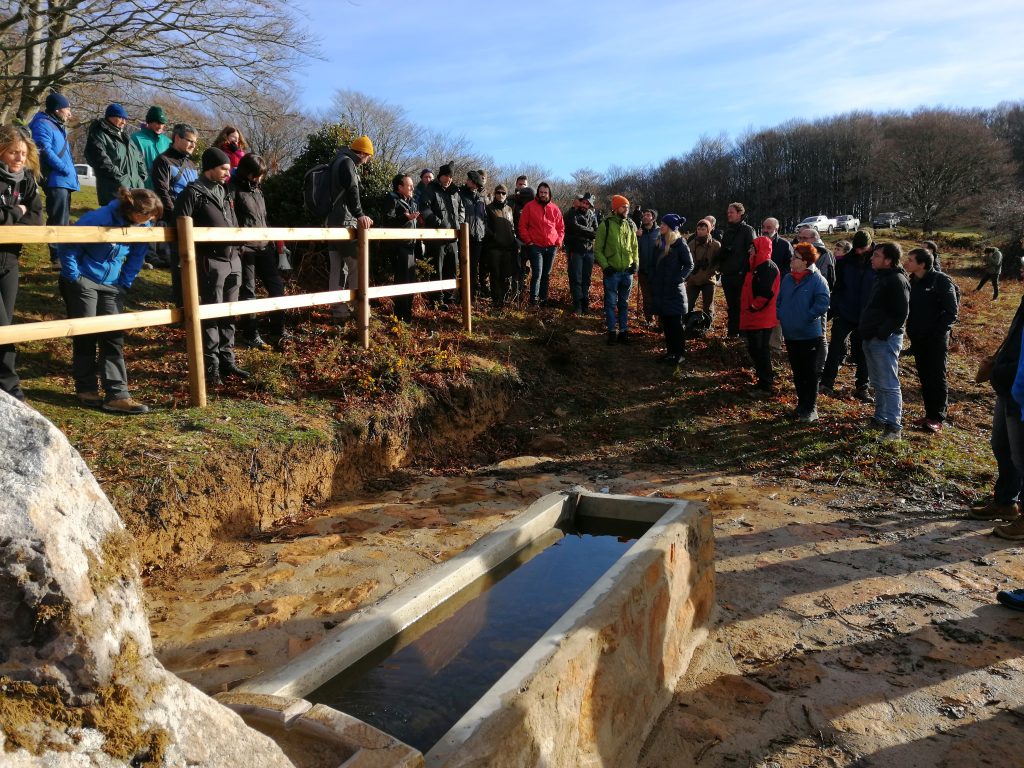 Indeed, the study visit started of with a tour of the Parketxe (welcome area) of the Aizkorri-Aratz natural park. The participants were then taken in off-road vehicles to the altitudinal pastoral areas. The vehicles first stopped in the region of Álava to show the participants an area where the Provincial Council of Álava had thinned the scrubs following a mosaic pattern, with the aim of recovering mountain pasture and acidophilus heathland, as well as providing a watering hole to encourage livestock farming in this area, which at present is underused.
The next stop were the fields of Urbia, where María Eugenia Amenabar, Manager of the Parzonería General of Gipuzkoa and Alava, explained traditional grazing use and the problems that shepherds in the area face today. This gorse-covered area was thinned by the Provincial Council of Gipuzkoa in 2015 and 2017, and now holds several monitoring plots of the LIFE Project. Isabel Albizu (NEIKER) and Vicente Ferrer (Belardi) gave explanations about the methodology used for monitoring. The ARC compa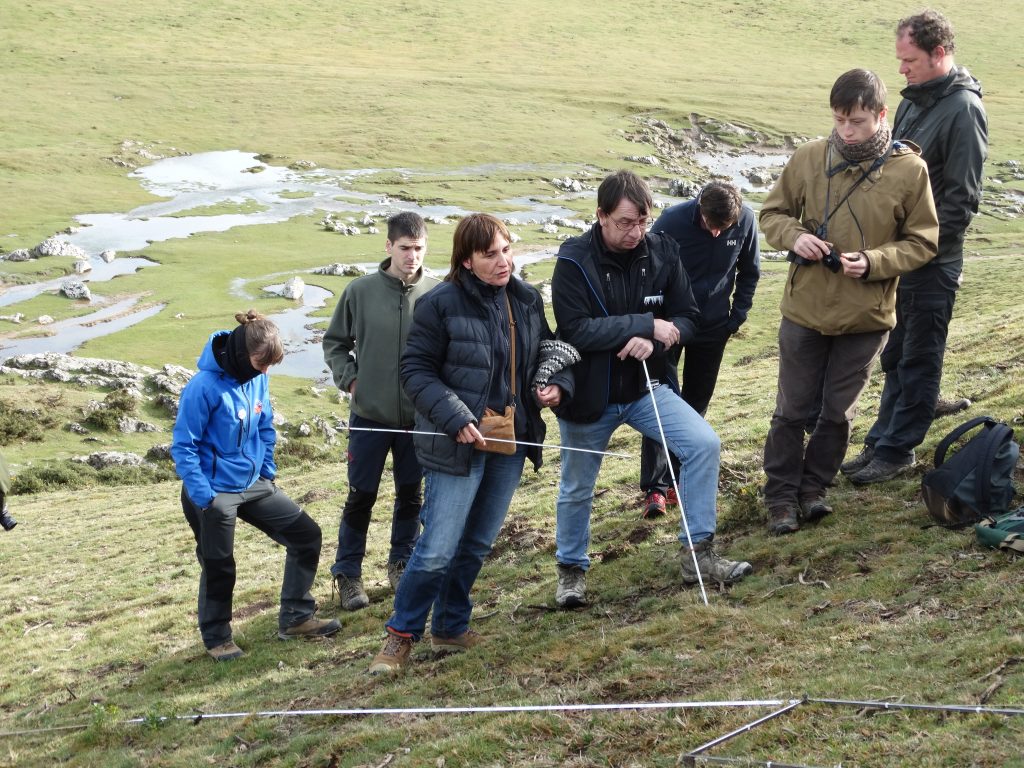 ny flew a drone over the same area, as this highly accurate photographic sampling technique is going to be used in the project to test a new method of monitoring scrubland development that complements the floristic sampling of transects in the previously mentioned fixed plots.
Lastly, the shepherds Mikel Etxezarreta and Eli Arrillaga opened the doors of their hut and gave us a detailed explanation of their day-to-day lives and described how cheese with the Mendiko Gazta label is made in the village cheese factory.
The Seminar attracted a high number of people. Nine lecturers and 106 participa nts with very different interests came from a variety of places (university academics, specialists from Basque institutions, agricultural research centres, rural development associations, livestock farmers, NGOs, etc.).
The presentations are available here below.
Presentations
- The shepherd, grazing and sustainability of mountain livestock (Koldo Osoro. SERIDA)
- Which support measures exist for pastoralism? European examples (Lauren Mosdale. Euromontana)
- The shepherd of the 21st century (Batis Otaegi. ARTZAIN ESKOLA)
- Examples of innovation for the sustainability of mountain farms (Iker Elosegi. EHLG)
- LIFE VIVA GRASS: integrated planning and ecosystem services of pastures (Zymantas Morkvenas y Justas Gulbinas. BALTIC ENVIRONMENTAL FORUM)
- Main advances of the project (Amelia Ortubay. HAZI FUNDAZIOA)
- SIGPASTOS (Javier Pérez. HAZI FUNDAZIOA)
- Monitoring of the restoration of blanket bogs using remote sensing (Guaduneth Chico. Universidad NOTTINGHAM TRENT)
- Monitoring with GPS collars: utilities for the shepherd and for science (Isabel Albizu. NEIKER-TECNALIA)
- Monitoring of thicket expansion using LIDAR and drones (Daniel Sáenz. HAZI FUNDAZIOA)


