



During the 2019 edition of the European Week of Regions and Cities “Europe Closer to citizens of Islands Mountains and Sparsely Populated Areas” was organised by DG REGIO on 8th October. Marie Clotteau – Director of Euromontana – was one of the panellists to reflect on post-2020 regional policy in these specific territories.
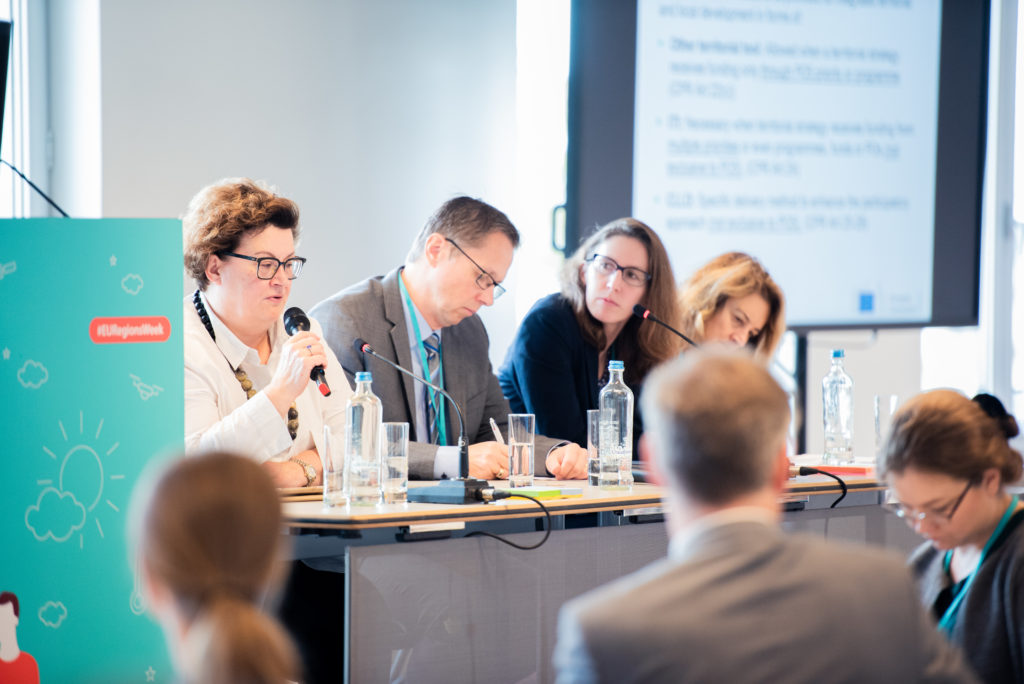
DG REGIO encourages the use of policy objective 5 in mountain areas
Wallis Goelen Vandebrock, Senior Advisor on Cohesion Policy implementation in areas with natural and geographic constraints at DG REGIO, introduced the new elements of the post-2020 Cohesion Policy. According to her, during the next programming period, the policy objective 5 “Europe closer to citizens” will be the main lever of action of the Cohesion Policy in mountain areas. The European Commission insisted on the importance of the sub-regional level (NUTS3) to build tailor-made and integrated development strategies, which should also be multi-sectoral, multi-stakeholders and multi-level. During the next programming period, the EU Commission also wants to prioritize the use of Integrated Territorial Investments (ITI) and Community-Led Local Development (CLLD).
Feedback from mountain areas on the Commission’s proposal
Marie Clotteau – Director of Euromontana – welcomed the opportunity given by the next Cohesion Policy to move towards the sub-regional level, enabling to shape strategies based on the specific needs of each territory with this policy objective 5 (PO5). Nonetheless with 80 % of the funds, in some regions, to be spend under the policy objectives 1 and 2, she encouraged the beneficiaries in the mountains to apply to other policy objectives and not to limit themselves to this PO5. She also welcomed the efforts done in the legislative proposals for further simplification, but encouraged both the Commission and the Managing Authorities to go further in this effort (develop more lump sums; unit costs systems; reporting could be simplified as done in other EU funding schemes).
Marie Clotteau also highlighted the lack of knowledge on ITI and CLLD at local and regional level. With only 5 examples in mountain areas at EU level, this new tool is not known sufficiently, is too complicated so far to implement and the Managing Authorities should support potential beneficiaries by building human capital and explain how to use these tools, otherwise, they won’t probably be used in a significant way in the next 2021-2027 programming period.
One solution for a wider use of CLLD/ITI tools was suggested by Euromontana, and other European stakeholders, such as the Conference of Peripheral Maritime Regions of Europe, for the European Commission to create a one-stop-shop at EU level.
An example of CLLD strategy in mountain areas was provided by Martin Traxl, Officer at the Department of Regional Development and Future Strategy Office of the Tyrolean Provincial Government, Austria. In a region where only 12% of the land is compatible with permanent settlement, the need for a tailor-made and inclusive approach was strong. Thanks to the important connection with Italy, the Tyrolean region implements both domestic and cross-border CLLDs. The region has made available a platform for all stakeholders involved in programmes at local level to exchange as well as a regional one-stop-shop for the management of all programmes, to avoid double structures at regional level and to ensure a good coordination of all European Structural and Investment programmes (including EAFRD). In the future, the Tyrolean Provincial Government wants to include in CLLD the concepts of Smart Villages and Smart Specialisation. Climate change issues are also a targeted topic to be included in local development strategies in mountain areas.
For more information on this event, please refer to the presentation of Mrs Goelen Vandebrock and to the presentation of Mr Traxl.
17 October 2019


