



Lower Engadine, Switzerland, is a peripheral area facing different issues common to other mountain areas such as depopulation, especially youth leaving for cities, loss of jobs and dependency to tourism. To address the challenge of attractiveness, the “MiaEngiadina” initiative decided to create different co-working places in the area, offering all necessary options for businesses development.
Jon Erni, founder of “MiaEngiadina”, launched the initiative in 2017 to propose inspiring working spaces in mountain areas, as a possible solution to the challenges faced by this territory. Beyond offering quiet areas to work in, these places are aimed at fostering innovation and teamwork in the region and can also boost the attractiveness of Lower Engadine. MiaEngiadina is a Swiss Foundation as well as a business involved in the development and maintenance of broadband in the region with the wish to bring different services together, to create synergies between workers and to generate economic activity in the region.
1. How did MiaEngiadina create co-working sites in the mountains?
4 co-working areas were already created by MiaEngiadina in different villages of Lower Engadine:
- In Scuol, the “Mountain Hub” was the primary area opened to workers and also offers a meeting room and a conference room for rent;
- In Ardez, a small co-working area proposes 2 co-working rooms;
- In Ftan, thanks to a specific collaboration with the Alpine Institute, a co-working area is hosted within the premises of the school;
- In Motta Naluns, the newest co-working place of MiaEngiadina was opened in this ski region. The idea behind, apart from stunning landscape, is to combine leisure activities and work.
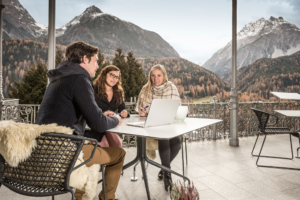
All 4 co-working places are equipped with a very fast Internet connection of 100Mbits/s. Workers can also use some equipment such as printers and photocopiers and even sometimes computers and flipcharts. Moreover, their localisation and structure reflect the different possible options and values collaboration with existing institutions.
A new site will also open in 2021. With 7.000 square metres, the InnHub La Punt will include working spaces and seminar rooms, shops with local products, a guest information centre and different other businesses targeting both local populations and tourists. Conceived as a modern interpretation of Engadine’s traditional architecture, the project involved regional architects and created jobs in the construction sector.
2. How to finance coworking areas in rural and mountainous regions?
The functioning of each coworking space is different. While some need to be booked in advance, the “Mountain Hub” in Scuol is opened on a daily basis during working hours. Because of its large opening hours and its wide range of equipment, this coworking area proposes different prices. For instance, using the space for only one hour is free while staying for the day costs 24 CHF. Monthly subscriptions are also available and can be a convenient option for new businesses. The other co-working sites are free of charge for anyone willing to use them.
Each site also received different types of support for their creation. The co-working space in Ftan, located in the Alpine Institute, was for instance supported by L’Aide Suisse aux Montagnards, a Swiss Foundation promoting the development of mountain areas since 1943. The association supported the initiative by donating IT equipment and by offering their expertise to shape an open learning environment. In the villages of Ardez and Motta Naluns, municipalities are involved in the projects as they own the buildings used as coworking areas and make them available for MiaEngiadina for free.
The new innovation and meeting centre InnHub La Punt was also financially supported by the canton, the region and the municipality which will benefit from the attractiveness of this new public place.
3. What are the benefits of developing coworking areas in mountainous territories?
As simple as it looks like, the creation of coworking places in mountain areas has many advantages for local populations. The initial idea of MiaEngiadina was to encourage teamwork, trigger creativity and boost innovation in the region. It also encourages social interactions between entrepreneurs and collective thinking that can bring forward new ideas for mountain areas.
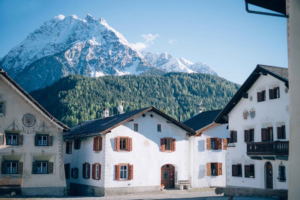 If coworking sites are indeed efficient to reach such targets, they also constitute places with good internet connection. This is a critical aspect in a territory where connectivity barely exceed 30 Mbit/s according to the OECD mapping of broadband. Providing a good quality Internet connection in the region offers possibilities for new businesses to settle in the area and for local workers to telework if they need to. Coworking places thus contribute to increase the attractiveness of the region.
For more information on the different coworking areas created by MiaEngiadina, their location and pricing, please visit their Website. You can also learn more on telework and coworking sites in rural areas in the presentation of Jean-Dimas Malot from Nièvre Numérique during the X European Mountain Convention in 2016 in Bragança.
Download the good practice in PDF.
8 November 2019


