



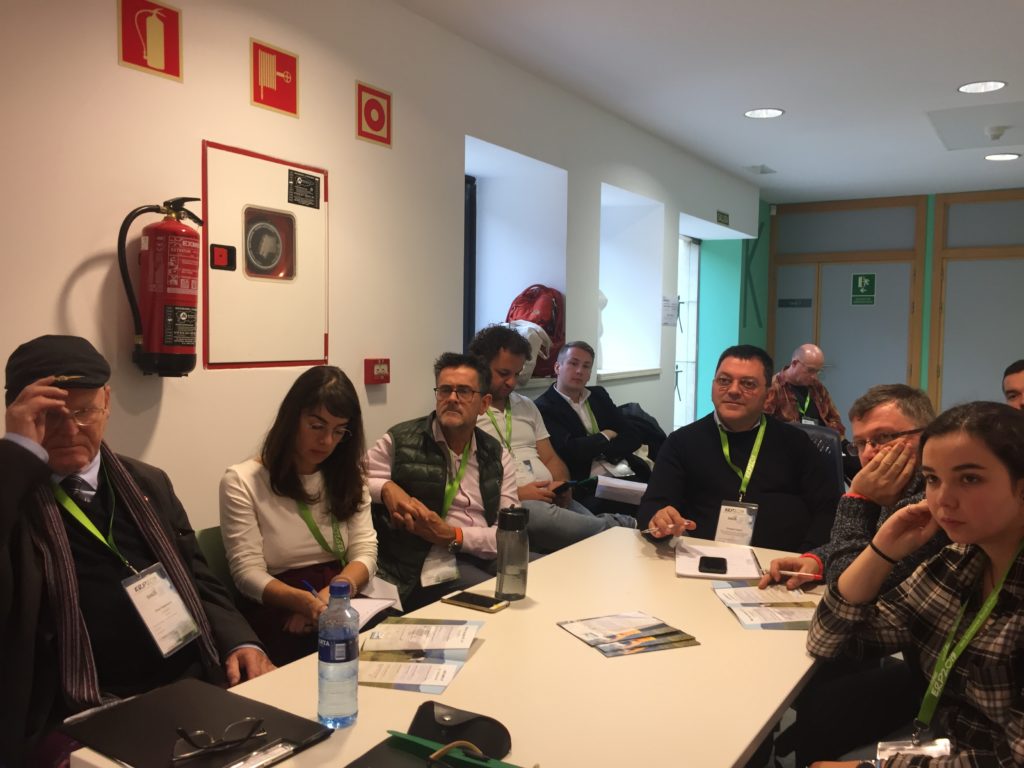
Euromontana participated this year to the 4th European Rural Parliament, organised by ELARD and held in Candas, Spain, on October 6-9, 2019. The European Rural Parliament is a long-term campaign to express the voice of rural people in Europe; and to promote self-help and action by the rural people, in partnership with civil society and governments. For this year’s edition, organised in the heart of the Asturian mountains, Euromontana organised a workshop on “How to govern smart in mountain areas?”, led by Laura Gascon Herrero, from the Province of Teruel and member of Euromontana’s Board of Directors, and Blandine Camus, Policy & Communication Officer at Euromontana.
Smart governance in mountain areas – experiences from the ground
Smart governance implies an integrated approach of territorial development and a co-construction process between public institutions, private organisations and civil society and helps to build a long-term strategy adapted to the specific needs of a territory. Far from being limited to the use of digital tools to involve local communities, smart governance can use different resources, from ICT to social innovations, and be applied at different territorial scales.
The use of smart governance models is particularly appropriate in mountain areas, where natural constraints require to implement territorial development policies at the most relevant scale to better answer the specific needs of the area. Moreover, smart governance plays an important role in our regions, where conflicts between different economic sectors or interests can sometimes emerge. Experiences show that innovative governance models can for instance help in the combination of tourism activities and protection of natural areas, of winter sport activities and the fight against climate change or more broadly in solving issues between local communities and tourists, farmers and environmentalists for instance.
 Different examples from Europe were introduced during the workshop, such as the newly created Massif Committees in Romania, which will help to identify Massifs’ needs and to build targeted policies at the most relevant territorial scale. With a mixed composition including both representatives from local and regional authorities and stakeholders from different economic sectors, Massif Committees will provide expertise on the needs of mountain areas. Recommendations will be shared with the National Mountain Council, where Presidents of the 9 Massif Committees meet with representatives from different relevant Ministries.
Another example is the toolbox produced by the Alpine Space project GaYa – Governance and Youth in the Alps. This project indeed came out with different tools to be used by policy makers to better include the youth in public policies and better involve them in the policy making process. By increasing the democratic participation of the Alpine youth, the objective was also to better address their needs and make them feel fully integrated in their territory.
Public participation is also the key tool of the Mountain Parliament of the Occitanie Region, France. Created in 2018, the Mountain Parliament aims at increasing citizens’ participation in public policies and at building collective strategies for the sustainable development of the region. Through an online platform, plenary sessions and working groups, mountain local communities are invited to step in and use their local expertise to make recommendations. It must also be noted that this governance model, with no binding effect between the Mountain Parliament and the Regional Council, was established to avoid any interference with French Massif Committees.
Finally, participants were introduced to the MedStrategy, a, EU MED project developed to build better governance models for the creation of sustainability strategies in Mediterranean areas. This was done through the definition of common objectives and the development of an integrated approaches between local policy makers and communities. On this basis, the Province of Teruel, Spain, for instance developed a strategy to reintroduce pastoral activities in the area. The same co-constructive and integrated approach led Crete Region to adopt a strategy on sustainability in the agrifood production.
How to better encourage smart governance in mountain areas?
Participants of the workshop highlighted the need for more initiatives of this type, to ensure a better inclusion of territories’ needs at the most relevant territorial scale. They however stressed the lack of local knowledge among local communities about the different levels of legislations and insisted on the need for more training and capacity building activities in mountain areas.
Moreover, administrative borders were identified as possible burden for mountain areas. In some cases, it was recognised as more efficient to build development strategies at Massif level rather than at the County or Region’s level. Mountain areas are shaped by natural borders, implying specific natural and geographical constraints, needs and potentials. During the European Week of Regions and Cities, this issue was particularly well illustrated by Nathalie Prouheze, from the Managing Authority of Massif Central, gathering 22 Counties and representing 42% of France’s mountain areas. With common challenges and specificities in this Massif, such as depopulation, lack of qualified manpower and lack of attractivity, building strategies and investments at the Massif level was considered as the most efficient option.
Thus, efficient territorial development in mountain areas also relies on a smart governance, involving local communities, experts and politicians to together reflect on the best tools to address their specific challenges. More pro-active citizens do not only mean a healthier democracy but also more efficient policies; therefore smart governance in mountain areas should also imply better coordination of policy makers and experts. A more efficient approach in the development of mountain areas can be encouraged through strategic planning for investments, for instance through Cohesion and Rural Development funds and with both bottom-up and top-down approaches such as CLLD and ITI.
For additional information on the examples presented, please refer to the workshop’s presentation or contact us. Read also the Declaration of Candás, from the European Rural Parliament 2019!
26 November 2019


