



 The 11th OECD (Organisation for Economic Co-operation and Development) Rural Development Conference was held in Edinburgh on 9-12 April 2018. Prior to the main conference, a series of interactive sessions, led by the European Network for Rural Development, showcased projects and approaches already launched by rural communities to face 21st century challenges and opportunities.
The OECD’s Rural Policy 3.0 is a framework to help national governments support rural economic development. The OECD envisions rural policy as an investment strategy to promote competitiveness in rural territories. The Rural Policy 3.0 focuses on identifying more specific mechanisms for the implementation of effective rural policies and practices.
Based on this Rural Policy 3.0 concept, the conference tackled the issue of rural innovation led by the following 10 key drivers of rural change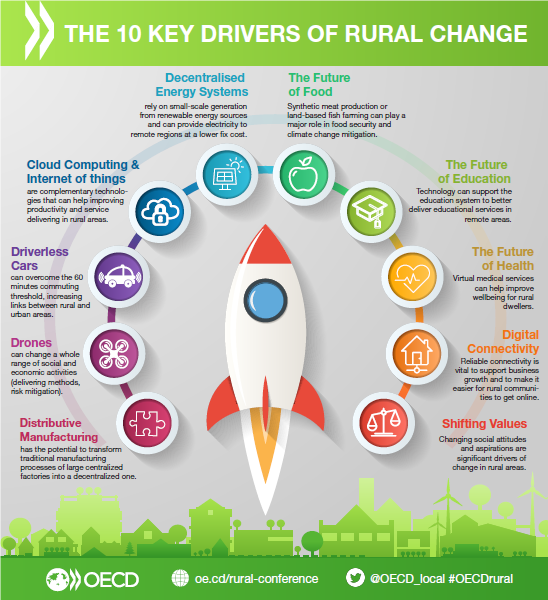 :
:
- Additive and distributive manufacturing;
- Drones,
- Driverless cars;
- Cloud computing and internet of things;
- Decentralised energy systems;
- Future of food;
- Future of education;
- Future of health;
- Digital connectivity;
- Shift in values and preferences.
“The most interesting topic for me was probably the new possibilities offered by technology, like driverless vehicles and drones. There are of course many questions regarding drones, especially in the field of security and safety. But if you could overcome these questions, you could use drones for bringing post, medicines and other necessities to people living in remote areas, far away from shops and post offices.”
– Torunn Kornstad, Hedmark County Council (member of Euromontana)
Several examples of successful rural innovations to respond to megatrends currently observed in rural areas such as ageing, urbanisation, climate change or digitisation, were showcased during the event.
- The Isle of Eigg in Scotland for instance managed to reverse demographic trends (population just climbed back up to 105 inhabitants, +60% since 1997) thanks to a community buy-out of the island and the development of a renewable energy grid for the island, a microbrewery, the creation of a music label and festival, and various other ventures including tourism activities.
- Skillnets rural enterprise developed training networks in Ireland, which are groups of private sector businesses, in the same sector and/or region, that come together to carry out training-related activities that may not be possible on their own.
- The Cocotte Numérique is a collaborative work space, open to teleworkers and business creators looking for a professional and friendly place. Created in 2011 in the French Massif Central, this coworking area aims to encourage the creation and maintenance of economic activities in rural areas, to disseminate the values of entrepreneurship and the collaborative economy.
- The Smart Specialisation Strategies enabled Lapland to develop the Artic Smartness branding and develop regional clusters (Arctic Industry and Circular Economy; Arctic Smart Rural Community; Arctic Design; etc) in a sustainable and multi-sectoral synergic way, which is helping them to overcome the region’s lack of critical mass and to integrate Lapland’s industries into global value chains.
- Rural Leadership Programme is a challenging programme led by Scottish Enterprise, aimed at business managers and employees from rural businesses who have a desire to develop their leadership skills and grow their business
- And many other examples, including winners and runners-up of the UK Rural Business Awards
“Rural regions are not synonymous with decline or agricultural specialisation, but places of growth, opportunity and inspiration, yet rural is still not central to government policy. Rural areas have a key part to play in some of our major global challenges. They are best placed to develop new energy sources, to help sustain our natural environment and to ensure food security. […] In an increasingly interconnected world, opportunities are emerging to promote rural prosperity. Digitalisation will propel rural economies forward, and the conference has highlighted that supporting innovation in rural areas will be key to the future prosperity and wellbeing of rural regions.”
– Jose Enrique Garcilazo, Head of OECD’s Regional and Rural Policy Unit
Rural areas are vital to national economies and addressing global challenges, according to the policy statement released at the end of the conference. The conclusions of the event encouraged rural policy to mobilise assets and empower communities in order to enhance the social, economic and environmental well-being of rural areas. Without this focus, rural policies risk recourse to subsidies for lagging regions, which can in the long run, lead to unsustainable dependencies.
In this context the Conference confirmed that a robust rural policy should:
- Place well-being at the forefront of rural policy objectives.
- Take a place-based view of rural development that considers the different conditions and needs of communities depending on their geographies/linkages and their local specific assets, such as a “natural capital”. Taking a place-based approach implies:
- Implementing an integrated approach and replacing top-down prescriptive approaches by result-oriented policies with room for local experimentation to favour policy synergies.
- Designing and implementing policies with a long-term perspective and promoting coherence between rural, sectoral, regional and national policy objectives, through collaboration across levels of government and with the public and private sectors.
- Develop rural-urban linkages to improve regional performance, achieve effective public service delivery and improve quality of life for residents.
- Promote societal approaches based on social innovation with a proactive role for local communities contributing to climate change adaption and mitigation while ensuring sustainability in rural areas.
- Empower communities to better understand and address the conditions and challenges they face in order to support community-led efforts.
- Incorporate the effect of demographic trends in rural areas on the design of public services, the functioning of rural labour markets, and commuting and migration patterns.
“Rural areas should seize the opportunities offered by innovation regarding not only new technologies, products or processes but also linked to the transformation of the business models, creating added value, using other approaches, such as fostering social innovation, where public and private support come together, emphasizing the community-led local development. On the other hand, it is vital to design flexible public programmes with measures that answer to a framework of integral support to rural areas. Support to business innovation is crucial if we want to contribute to having vital and attractive areas both for young farmers and other entrepreneurs. Those programmes should provide entrepreneurs with an itinerary support on a long-term basis and it is very important to foster synergies between different programmes, measures and funding schemes.”
– Jone Fernandez, HAZI (member of Euromontana)
What particularly came out of the discussions during these three days of conference was the need to cultivate leadership in rural communities for new initiatives to emerge, as well as to develop more soft skills in rural areas in schools, training centres and through life-long learning – which regrettably did not appear in the final policy declaration. Indeed, many of the recommendations resulting from the conference, with which we can only agree, have already been identified by certain European policies (cohesion policy, agricultural policy, etc.) but have not been elevated to the rank of priorities, which hinders their implementation. The conference was nonetheless rich in exchanges of experiences and debates and the many attending Euromontana members were able to leave home with new perspectives to explore.
19 April 2018


