



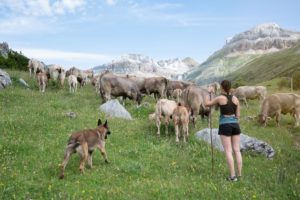
 Over the past decades, the abandonment of mountainous areas has largely been due to the reduction in the number of pastoral farms and shepherds. In the last months, the Food and Agriculture Organisation of the United Nations and the PASTRES project released new reports to address the topic from the policy side and explain how policy frameworks should support pastoralism.
A long-lasting worrying trend of pastoral activities
Pastoralism is crucial to maintain mountain areas liveable and productive. As reported by the OREKA MENDIAN study, livestock production – in particular meat and dairy – accounts for 54% of the turnover of mountain farms at global level.
Yet, pastoral practices are today put highly in danger due by socio-economic changes, such as land use pressures and the globalisation of food markets, and climate change. Over the past decades, the decrease of pastoral farms contributed to lead to the desertification of mountain areas at worrying rates. For instance, some regions like Scotland experienced percentual reduction in the number of sheep equivalent to 27%, and 11% in cattle over the 2000-2010 period.
What is the role of policy framework?
Policy frameworks has the central role to support pastoral activities by making them economically viable and able to offset the ongoing socio-environmental challenges. In this direction, the PASTRES project published an analysis of policy frameworks that impact pastoral areas in Europe.
As argued in the PASTRES report, European policies recognize “its precious and irreplaceable role for several environmental, economic, and cultural benefits” and they support it in mountain areas through the payments for Areas with Natural Constraints and the “Farm to Fork” strategy. However, the report claims that in practice the EU institutional architecture and the Common Agricultural Policy is still more likely to favour the intensification of livestock production rather than pastoralism and is one of the main uncertainties for shepherds.
Alongside, the recent report of Food and Agriculture Organisation (FAO) “Making way: developing national legal and policy frameworks for pastoral mobility”, claims that worldwide the policy frameworks insufficiently recognize the role of pastoralism and define supportive policy frameworks to address the pastoral mobility.
What are the conclusions?
Both reports come to the conclusion that at European and global level, the benefits of pastoral activities for the whole society shall be better acknowledge by policy frameworks. In practice, this shall translate in legislations that simplify and support the work and lives of shepherds and pastoral systems. These legislations shall develop based on the current analysis of good and bad practices, as presented in the PASTRES and FAO reports, as well as by the OREKA MENDIAN study. To this end, the promotion of an EU Action Plan for Pastoralism could go in this direction and concretely strengthen the measures to support pastoral activities at European level.
11 March 2022


