



Forests are already a very important renewable resource. As demand for renewable resources increases, in the future, forests will have to be managed to maximize output while ensuring forest sustainability. The use of different technological solutions and platforms based on spatial data allows to understand the state of the forest and, thus, to more effectively manage a forest. GDi solutions is a technological solution based on spatial data that assist in forest management through monitoring, data analysis, and planning. The tool helps to keep forests healthy, supports the provision of ecosystem services and ensures that the maximum benefit is obtained from forest resources.
Context
Often, foresters do not know the condition of their forests in details. At the same time, forests face many threats from diseases, pests, climate change, deforestation, pollution, etc that should be better known in order to be better managed. While some data is already available, fresh data is needed to help forest owners and government officials to monitor the state of the forest, and software solutions allow to automatically indicate problematic areas.
How the GDi tool can be useful?
 Among the existing technological solution based on Geographical Information System (GIS) that exist, GDi is one of them. GDi focuses on a quality monitoring system that collects data from different sources (through drones and satellites, for instance) and places them in one geo-enabled database that will allow for more efficient and effective forest management. Forest owners and government officials can subscribe to a service to have access to the database.
The main objective of GDi is to establish a forest monitoring system that improves: (a) inventory, (b) land administration, (c) sustainable forest planning, and (d) the management of timber exploration. With these estimations in hand, forest managers can assess the state of their forests and better ensure forest health.
Innovative results and impacts
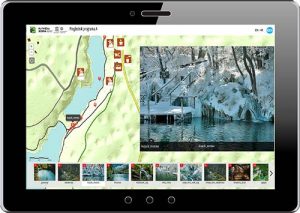 Novel software solutions and new data collection techniques bring many advantages and improvements to the existing forest monitoring systems. Such systems allow forest management decisions to be made based on facts, not guesses about the state of the forest. The benefits of these solutions are: fast and accurate decision making, monitoring in real time, assistance in the management of forests all along the forest cycle, and cost optimization.
The technological solutions provided by GDi allow for better forest management which in turn results in faster growing, healthier, and productive forests that can provide primary resources and ecosystem services.
Challenges and places for improvement
Many foresters do not use GDi or any other Geographical Information System tool and have not included the technology in their budget plans. Even if they recognize benefits of the solutions, they may not have funds to implement the technology. Nonetheless, tthe use of GDi software solutions bring benefits to foresters, including in mountain areas where slope, altitude and snow might make it more difficult to understand the state of the forest. New technology brings more efficient and accurate tools for forest management and monitoring. Many different data sources about forest conditions enable more relevant inputs for management and monitoring tasks, but the sector has to be trained to use the new tools.
For more information, visit the GDi’s website
30 January 2018


