



Pastoralism faces a wide range of different challenges in Europe, from land use to climate change and large herds management. In Thessaly, Greece, cooperation Terra Thessalia developed a GPS tracking system in Thessaly to facilitate pastoral activities but also communication between farmers’ and other actors such as foresters and consumers.
1. Why a GPS tracking for mountain herds?
Selling mountain products can sometimes become a difficult task when it comes to justify the quality and sustainability of foods. Ensuring quality is critical for mountain products, since it is key to highlight the specificities of mountain extensive agriculture but also to ensure fair income to farmers in areas with geographical constraints.
 To address this issue, the Greek cooperation Terra Thessalia developed a GPS tracking system in Thessaly, Greece, in cooperation with the EU-funded project LACTIMED (Promoting Mediterranean Dairy Products) to track the mountain herds. This innovation is part of the Participatory Guarantee System for the “Terra Thessalia Lactis” label for dairy products and is used to guarantee the producer’s extensive pastoral practices. The application was implemented due to the need for a reliable tool accessible to consumers that would also guarantee the grazing of the herds.
2. Consumers’ control over their consumption of sustainable meat and dairy products
During the project, new techniques to geolocate herds were developed and tested in 15 livestock farms. This resulted in the development of a GPS tracking collar. By outfitting livestock with this collar, the herd’s daily movements in mountain areas can be tracked. Collected data allows farms to be certified with sustainable grazing practices and sell their products under the Terra Thessalia Lactis label.
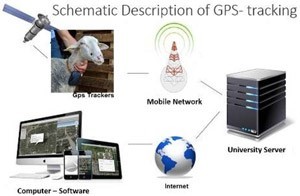
Moreover, the livestock tracking data is stored in an online database and can be accessed by consumers so they can verify the extensive grazing of livestock. The GPS-tracking serves as a certification tool for the extensive grazing of herds and contributes to the products’ added value. High Nature Value farming such as pastoralism directly benefited from the use of GPS-tracking since it helped to increase products’ added value on the market.
By making data on livestock movement available, it reinforces confidence with consumers interested in supporting the multiple benefits linked to the extensive farming system, such as sustainable use of natural resources, biodiversity conservation and landscape quality. Thus, it allows these farms to differentiate their dairy products from other products produced in other Greek regions. The GPS-tracking can be installed on any extensive livestock holding with mobile signal.
3. Indirect benefits of GPS-tracking in mountain pastures
The use of GPS-tracking also implies indirect financial benefits for farmers, especially in cattle holdings, tracking the movement of the animals in the countryside (free range for approximately 6 months) helps to save sick-trapped animals and minimizing the cost from animal losses, as also explained by Marit Mjøen Solem, founder of FindMy in Norway.
Such devices also offer additional benefits for the management of mountain grasslands:
- It facilitates grassland management, avoids over-grazing of certain pastures and helps collecting data on the pasture quality (quantity of biomass, biodiversity and plant species)
- It allows data collection for pasture quality control
- It helps preventing conflicts between farmers and forestry services
The initiative was part of two EU-funded projects LACTIMED (2012-2015) & HVN-Link (2016-2019), which helped to understand farmers’ needs and to design this innovative tracking model.
More information
For more information on this initiative, please visit Terra Thessalia’s Website. If you are looking for more examples of innovative projects related to pastoralism and to the management of pastures, please see our LIFE project OREKA MENDIAN, which will come out in 2020 with a full report on the sustainable management of mountain grasslands later in 2020.
Download the good practice in PDF.
13 December 2019


