



Horizon Europe is the follow-up of the Horizon 2020 research programme for the next European programming period 2021-2027. The European Commission has started to prepare for the programme’s implementation, including through a co-constructed approach. The European Research and Innovation Days, organised from 24 to 26 September 2019 in Brussels, was the first annual policy event of the European Commission, bringing together stakeholders to debate and co-design the future research and innovation landscape.
Taking into account the results of this event, together with more than 6000 responses from the Horizon Europe online co-design consultation, the Commission will be able to make progress on the first ‘Horizon Europe Strategic Plan 2021-24’ before the end of 2020. This ‘Horizon Europe Strategic Plan (2021-2024)’ will identify major policy drivers, strategic policy priorities, and targeted impacts to be achieved. Euromontana participated in September 2019 to the Horizon Europe online co-design consultation, read our entire contribution.
What is the place of rural communities in the future Horizon Europe research programme?
In its current version, Horizon Europe integrates the social dimension of rural areas mainly under Cluster 6 “Food, Bioeconomy, Natural Resources, Agriculture and Environment” piloted jointly with DG AGRI, although there will certainly also be calls for proposals published targeting rural areas in Cluster 5 “Climate, Energy and Mobility” and Cluster 2 “Culture, Creativity and Inclusive Society”.
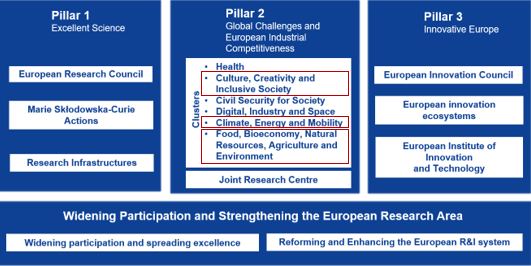
DG AGRI’s preliminary objectives for Cluster 6 are the following (the detail is available in the Orientations working documents):
- Reduce emissions and adapt ecosystems, production systems and communities in general to climate change
- Halt biodiversity decline and restore our ecosystems
- Enhance the sustainable and circular management of natural resources together with value creation for the well-being of people
- Develop production systems that are based on sustainability and inclusiveness
- Improve the understanding of the drivers of behavioural socio-economic and demographic changes
- Establish governance models that enable sustainability
The overarching aim is to develop knowledge that is needed for rural areas to fully take part in the sustainability and climate and social agenda, both through knowledge creation – including technology development – and through investments in place-based bottom-up innovation which could empower rural communities.
How did rural stakeholders contribute to co-designing Horizon Europe objectives during the Research & Innovation Days?
During a session on “Innovative, smart, vibrant and circular rural areas” at the Research & Innovation Days, Elisa Ravazzoli, member of the SIMRA project, delivered key messages to DG AGRI to be taken into account during the Horizon Europe strategic planning. Based on the evidence collected during the project, research and innovation should:
- seek to enhance social capital in rural communities and increase local leadership;
- design processes which engage local agency into the decision-making processes and in policy design;
- better understand the hindering or supporting policies as well as market obstacles to social innovations development in rural areas;
- be more effective in its dissemination of results both to local stakeholders and to policy-makers.
 Whatever the rural innovation may be, from digitalisation to environmental projects, research must engage with existing community-led initiatives and with the local practitioners. These messages were broadly supported by other members of the panel, Enrique Nieto from AEIDL (the European Association for Information on Local Development) and Francesca Whitlock from ECOLISE (the European network for community-led initiatives on climate change and sustainability). Watch the recording of the session.
Conclusions of the event to feed into Horizon Europe’s strategic planning
Outcomes of the Research & Innovation Days included a need to better balance research funding between curiosity-led research and applied research. Indeed, curiosity-led research is often at the origin of major scientific discoveries on one hand, but applied research is needed to solve targeted challenges today in Europe such as reducing ocean and water contamination by plastic, reversing the biodiversity decline trend, curing illnesses, etc. However, the overall role of social sciences and humanities also needs to be improved and integrated in European research programmes as the development of new technologies goes hand in hand with their impact on society.
This event will be organised annually by DG RTD so there will be more opportunities for co-constructing the future Horizon Europe calls. The Horizon Europe implementation strategy is expected to be finalised at the end of 2019 based on the results of the consultation, in conjunction with the adoption of the Horizon Europe Strategic Plan (2021-2024). The implementation strategy will cover, among other aspects, the organisation of calls, evaluation of proposals, grant agreements and project management. There will be a separate consultation later in the year on these practical issues which need to be put in place to help deliver the objectives of the new programme.
3 October 2019


