



Last March 14, 2019, Euromontana participated to the joint conference of the European Economic and Social Committee and the European Rural Parliament “Making rural areas the engines of a sustainable Europe”. The event aimed at addressing the future of rural areas not only to enliven them so that people want to live and work there but also to highlight promising perspectives when it comes to implement a sustainable Europe. Juanan Gutierrez, Euromontana’s President, was one of the panellists and had the opportunity to stress the potential of mountain areas in our quest for sustainability.
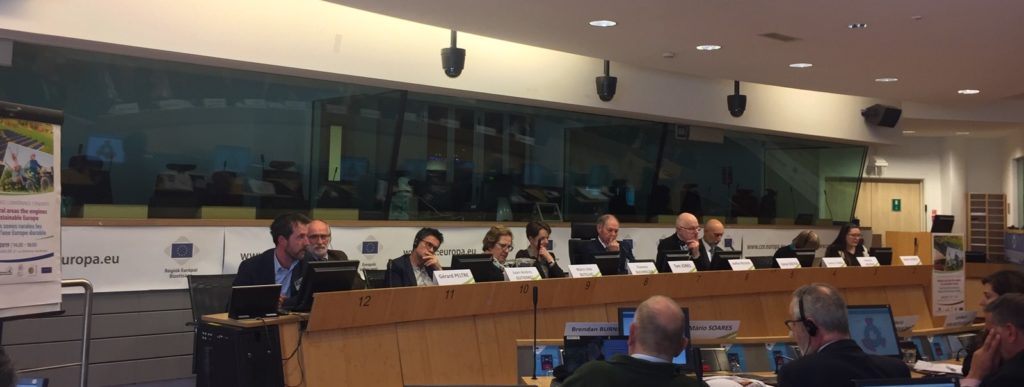
CAP post-2020 opportunities for rural sustainable development
Florence Buchholzer, DG AGRI, reminded that in 2017 European Commission organised a public consultation, followed by a paper on modernisation and simplification of the CAP. The European Commission concluded that the CAP should support a more sustainable agriculture, which could contribute to all SDGs except from SDGs 10, 14, 16 and 17. The next CAP will also be linked to the EU’s reflexion paper on sustainability by 2030, which focuses for instance on:
• Moving from a linear to a circular economy
• Encouraging sustainability from farm to fork
• Guaranteeing a socially fair transition
The LEADER funds also appeared as a useful tool to promote sustainability in rural areas. Maria João Botelho, President of the European LEADER Association for Rural Development, welcomed the continuity of the LEADER programme in the next CAP, as it offers local authorities more flexibility to shape rural development measures. Gérard Peltre, President of Rurality-Environment-Development (R.E.D.), supported this statement and at the same time pointed out that the development in rural areas should not be limited to agriculture.
“Mountain areas have the ambitious goal to be vibrant”
Juanan Gutierrez, President of Euromontana, expressed the association’s wish for an ambitious CAP for specific zones, such as mountain areas, while budget cuts in the next Multi Annual Framework are darkening this possibility. He also raised the importance of regions and their role in shaping the post-2020 CAP, a position officially shared by the Committee of the Regions.
For Juanan Gutierrez, mountain areas have the ambitious goal to be vibrant. While the agricultural production in mountain areas is limited, they focus on quality and diversity. In addition, biodiversity, water and landscape in European mountain territories are significant opportunities when it comes to sustainability. In areas where pastoralism is widely spread, he also called for a balance between agricultural activities and biodiversity protection.
Beyond the CAP, Juanan Gutierrez, stated that innovation had to be supported and that other funds than the European Agricultural Fund for Rural Development (EAFRD) needed to be involved in making rural and mountainous areas sustainable, such as the LIFE programme for instance.
“In our rural areas, we need to live, to study, to be trained, to be cultivated, to work and to be mobile”
While discussions mainly focussed on the CAP post-2020, many speakers called for a wider policy on rural development than Pillar II of the CAP. Panellists also highlighted the need to develop a better offer on internet coverage, cultural programmes, mobility and job creation, tackling at the same time vitality and sustainability dimensions of rural areas. Guillaume Cros, CoR Rapporteur on the CAP post-2020 and Vice-President of the Regional Council of Occitanie stated “in our rural areas, we need to live, to study, to be trained, to have access to culture, to work and to be mobile”.
More information
All presentations from the event can be found here. You can also watch the conference, including Juanan Gutierrez’s intervention, here.
19 March 2019


