



Rewarding 15 years of Euromontana commitment to the topic of mountain products, the use of the optional quality term (OQT) “mountain product” was protected in November 2012 by the European Union with the (EU) regulation No 1151/2012. Following that, the European Commission adopted the delegated act (EU) No 665/2014 in June 2014. Since then, several countries have moved forward with the implementation of the OQT at national level. The delegated act gave some room for manoeuvre to Member States (MS) in the implementation of the term.
Euromontana has monitored this process in seventeen countries so far to provide a state of play of the implementation of the OQT in the European Union. First published in 2016, and updated in 2017 and 2019, Euromontana’s 2020 report analyses three different situations in:
- Countries that have implemented the EU regulation without specific national adaptation
- Countries that have adapted or are in the process of adapting the OQT regulation at national level
- Countries that have not yet implemented the OQT on their territory
This study also takes into account the most recent developments, in particular in Bulgaria, Croatia and Romania, and provides national statistics on the uptake of the term and showcases examples of brands or operators using the OQT “mountain product”.
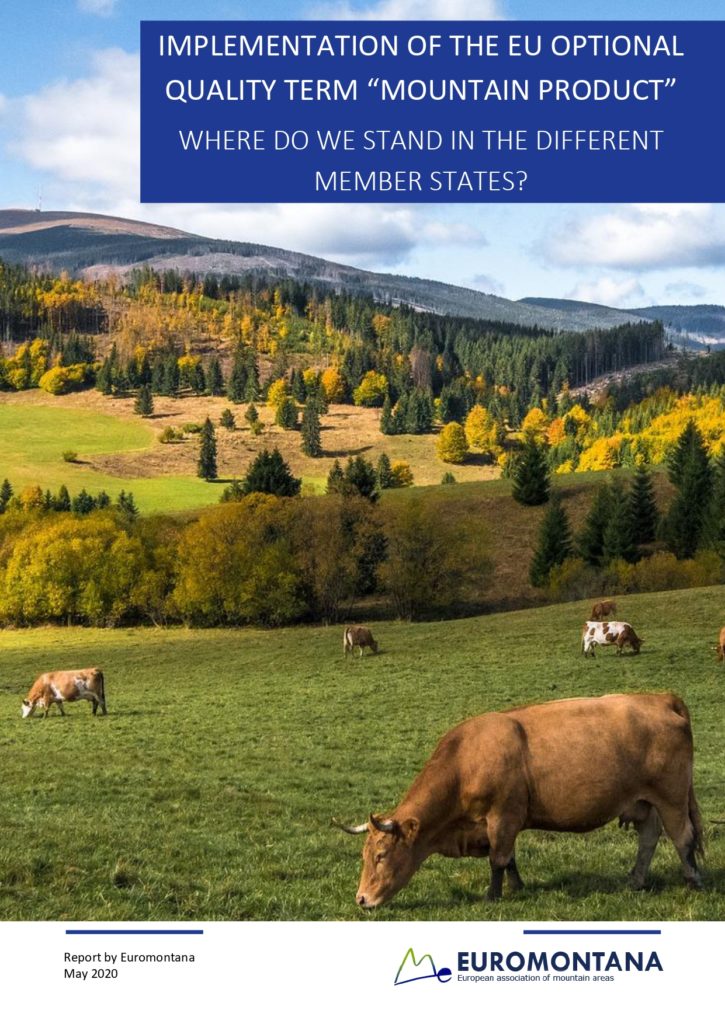 Mountain products are quality and sustainable products that contribute to the continuation of traditional know-hows, the preservation of mountain farming, the provision of fair income for farmers, the maintenance of landscapes and the protection of mountain’s biodiversity.
For the MS lagging behind, Euromontana therefore calls upon Member States to accelerate the implementation of the optional quality term and to implement adequate control systems while launching large communication campaigns to inform farmers about this opportunity. Moreover, Euromontana encourages the European Commission to remind their MS about this OQT possibility and to do a follow-up of its implementation, including in the Farm to Fork Strategy to ensure the production of quality food in Europe.
Learn more on the implementation of the OQT “mountain products” in our study!
10 June 2020


