



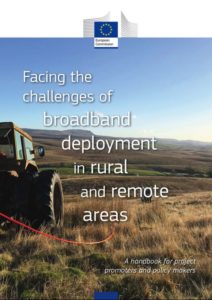
The European Broadband Competence Office (BCO) published a handbook on rural broadband, as part of the European Commission’s Action Plan on Rural Broadband. Targeting both promoters and policy makers, it presents solutions to improve broadband coverage in rural areas, introduces available investments and European funding opportunities, and showcases various good practices.
Essential investments for a higher territorial cohesion
In rural areas, connectivity brings countless opportunities for the development of SMEs and remote working, in the agriculture sector (e.g. livestock monitoring) and for the provision of health services in less densely populated areas (e.g. telemedicine). The COVID-19 outbreak highlighted the need for more investments in rural broadband to support territorial development As reminded by BCO’s handbook, the lack of rural connectivity infrastructures results from low density of population, brain drain and ageing population, combined factors that alter the viability of broadband infrastructures in some rural areas, including mountain territories.
 To bridge the Internet divide between urban and rural areas, different EU funds can be used to support broadband development in rural areas, such as:
- the European Structural and Investment Funds (ERDF and EAFRD in particular)
- the European Fund for Strategic Investments (EFSI is a European Investment Bank fund supporting strategic investments in key areas such as infrastructure, energy efficiency and renewable energy, research and innovation, environment, agriculture, digital technology, education, health and social projects.
- Connecting Europe Facility (for instance with the WiFi4EU initiative)
- the Connecting Europe Broadband Fund
Already, these funds have delivered broadband investments for approximately 15 million euros for the 2014-2020 period. It is already announced that for the upcoming 2021-2027 period, financing to digital infrastructures across EU countries will be renewed and even enhanced by ERDF and EAFRD and Connect Europe Facility 2.
Get inspired by European good practices
The handbook also showcases several examples of successful initiatives aiming at developing rural broadband in Europe, including through initiatives led by local authorities, rural communities, and promoters and with different types of funds.
In Verrua Savoia, in Piedmont region, Italy, the municipality and the iXem Labs of Polytechnic University of Turin together set up the infrastructures. Thanks to a low-cost broadband last mile Intranet network and the eight Wi-Fi and high-performance local area networks, developed by the University, 99% of the 1500 inhabitants of the village are now connected to the Internet.
In Komen, a rural Slovenian municipality, the local authority and a national operator together constructed 65 km of optical backbone and 110 km of optical overhead cable to build a network with fiber to the home connectivity. With a 10 Gbps speed, the developed infrastructure provides inhabitants with a high-speed connectivity, facilitating remote working and encouraging the creation of local companies.
For further inspiration on the topic, you can also read our latest good practice to learn how a Greek village developed a community Internet network in the mountains. For more information on connectivity in your country, please consult the European Commission’s national factsheets on broadband.
22 May 2020


