



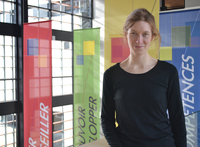
 ISARA is a graduate college in agricultural, agribusiness and environmental sciences, located in Lyon in France.
Since the early 2000s, ISARA has been a member of Euromontana and collaborates on various projects with other members of the network. We met and discussed with Audrey Vincent, teacher and researcher at ISARA, to discover what the “mountain course” is and to learn more about ISARA’s research and teaching activities on mountain issues.
Euromontana: Could you introduce ISARA and its specific course on mountains?
Audrey: “ISARA has about 900 students who are enrolled in a Master or an engineering course. Our main activities are teaching, research and consultancy. For the past 5 years, we have been organizing a module dedicated to mountain issues. The objective of this course is to familiarize our students with environmental issues, rural development and mountain product valorisation. The course lasts 2 weeks and is given in English to the 4th year engineering students, or international students who are part of an exchange programme. Its particularity is that there are several external contributors including professionals, such as Euromontana and some of its members.”
What are the topics covered during this mountain course?
“The mountain course allows us to study the challenges that mountains face today, to show how local actors can respond to them and to analyse how public policies can contribute to mountain development. To address these issues, the course looks at the role of agriculture, its interactions with other activities such as tourism, and the valorisation of mountain products.”
What are the future prospects of this course? Will it continue or develop in the next few years?
“Yes, the thematic of development and mountain issues has always been part of the school’s identity and it’s still the case today as we are located in the Auvergne-Rhône-Alpes region, the largest mountain region in Europe. The mountain course is intended to continue. Moreover, from 2019, the course will address other topics and will last for 3 weeks, instead of 2, We hope that other Euromontana members will join us and come to share their experiences and work with our students.”
ISARA has been working with Euromontana for almost 20 years, is being part of a mountain network still useful for you today?
“Of course. ISARA’s interest to join Euromontana was to integrate into a European network in order to do some networking, to connect with other organisations working on mountain issues. ISARA has always been willing to share experiences and learn from other members. Still today, being a member of Euromontana feeds our teaching, research and consultancy activities, because being involved in a network with professionals allows us to be in step with the realities on the ground in our activities.”
Have you already used Euromontana’s network to participate in European projects with other members?
“Yes. There have been different projects in which ISARA has been involved with other Euromontana’s members, including a project on behalf of the European Commission’s Institute for Prospective Technological Studies (IPTS), in partnership with Euromontana and the University of Highlands and Islands, which focused on the issue of labelling mountain products. The project ended in 2012, but Euromontana continued to work on the valorisation of mountain products and launched the European Charter for Mountain Quality Food Products.”
Do you have projects or themes that you would like to focus on in the future?
“For the future we would like to continue to work on issues related to the development of mountain products, spatial management and agricultural development in mountain territories. We are particularly interested in the issues of building local value-added supply chains and links between agriculture, the environment and local development, by working for example on ecosystem services provided by mountain agriculture. What interests us is also to see how the public policies can accompany these territories in the transitions to come. We would be very happy to collaborate with other Euromontana’s members on these topics, and even to set up a project together.”
The call is made !


