



By Tor Arnesen, senior research scientist at the Eastern Norway Research Institute
About half of the Norwegians has access to a second home, and many people divide their time and lives between an apartment in the city and their cabin in rural mountain areas. When the COVID-19 crisis hit in March, the Norwegian government instructed, by emergency law, second home households to leave the mountains and return to the cities. The reason: the emergency preparedness in the rural mountain municipalities hosting second homes, is not capable of dealing with as many people as they de facto have in their community when second home households are counted in.
And they are not, not under normal circumstances and not in extraordinary situations like this one. But isn’t that what emergency preparedness being all about, dealing with extraordinary situations? And on what conditions should ban on visiting second homes be accepted as a regular emergency preparedness policy instrument?
 Tor Arnesen is senior research scientist at the Eastern Norway Research Institute and member of Euromontana’s Board of Directors. He tells us about the challenges around instructing second home households to leave the place they call ‘their mountain home’. Arnesen pleas for putting this multi-house home lifestyle and social structure on the agenda to ensure that emergency preparedness in mountain areas is strengthened for future crises – also for the benefit of rural mountain municipalities. Rural mountain areas could be seen as a resource in a pandemic situation, but how should we organize society to tap into this potential resource?
First things first: a joint public effort to combat COVID-19 requires sacrifices and for a period of one month being instructed by emergency law to journey back home to the cities from our cabins is a very low price to pay this time around. It is acceptable because the situation took us as a society unprepared. The more interesting question is what the extraordinary policy revealed? What strikes one in the eye is that after the crisis is over, we must provide the relevant mountain municipalities with the tools and resources that would leave us all better prepared for the next time a similar crisis should occur – as it will.
For the past three decades, Eastern Norway Research Institute at Inland Norway University of Applied Sciences have been researching second homes as a social phenomenon or a trend that has in a fundamental way introduced a new type of organisation of households’ family life. Home functions are distributed over more than one house. Households circulate between daily life in the city and weekend and holiday recreational life in mountain hinterlands – they run a multi-house home.
Return to the city
The coronavirus pandemic has clearly revealed this, such as when the authorities must resort to a temporary prohibition by law on residence in second homes. However, this is clearly a short-term measure – albeit “tolerable” in the current time of crisis management and given the element of surprise when facing a grave situation unprepared. The law was complied with. Households returned to cities, even though cities are the “epicentres” of the pandemic while there has been “safety in the mountains” with very few cases of infection. Even at The Norwegian Institute of Public Health, professionals’ voices stated that the ban has nothing to do with infection control, and that it would be a good thing to get people out of the cities. The ban came as a political response after several mayors in rural mountain municipalities confronted the government with strong concern that their preparedness was not designed to take care of their second home households in this a situation.
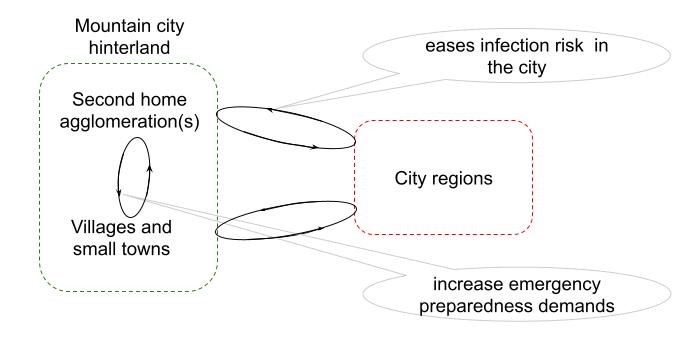
A minor, but vital information to grasp the spatial context of the deliberations related to risk of infection versus available emergency preparedness capacity: The triangle. Somewhat simplified; households circulate from the city to mountain hinterlands to their second home located in agglomerations well outside traditional small towns and villages. The circulation between the second home agglomerations and mountain villages and small towns has its own rational, mainly a drive-through, for provisioning and some service purchases.
So, there is a debate in the wake of this crisis, a crisis that clearly shows that society have been caught off guard in the circulation between the second home agglomerations and mountains villages and small towns. Why addressing this as a problem of pandemic relevance? The concern is not to adapt society to what could be conceived as a luxurious way of living and give in to unsustainable consumption by those well off to enjoy their elite way of life. It may well be.
Benefit rural society and safety measure
There are, though, two more important concerns here. Second home developments in rural mountain municipalities is a resource that should benefit rural societies themselves by demanding a strengthening of preparedness to be addressed by the government. Further, there is “safety in the mountains” in many situations where cites are especially vulnerable to crisis, pandemics is only one of them. And as the corona crisis has awaken the world to a new understanding of preparedness, it is important to develop new preparedness policies to better exploit the potential of “safety in the mountains”.
Civil infrastructure
In the end, it is not a viable solution to ban households from being in their own homes, even though these may be second homes, nor is it sensible for rural municipalities to ask them to head home when a crisis like this reappears – as it will. The research challenge and political task is to find out how we can develop the civil infrastructure in a way that strengthens both rural areas and cities.
When it comes to the emergency healthcare problem, we must acknowledge that many Norwegians now divide their lives between their home and their cabin – the second home fulfils functions that are in integrated part of a home.
Strengthening the paramedic in mountain areas
One possible solution is to significantly strengthen the paramedical offering. This applies not least to the ambulance services whether by ground or air – which are nowadays becoming an advanced medical offering where the patient can receive vital and highly skilled first responder treatment while being transported to the full hospital treatment.
This benefits mountain municipalities or areas with many second homes. The absolute bulk of these are rural municipalities that are within a radius of about two to three hours by car from our city centres. Better paramedic services will, of course, also be highly beneficial for the entire community in mountain municipalities – not least nowadays when we centralize hospital services.
Significant strengthening of paramedical services will be costly, but this is a consequence of the second home structure we have developed since the late 1980s. The mountain municipalities should now understand that after A comes B; after development, the civil infrastructure must follow. This is the modus operandi of social planning and it is a central government responsibility.
Norway needs to make this a political task that should preferably be addressed before another crisis arrives. The solution of asking people to head home when they actually are in their own home – second or first – should, perhaps, have no future.
4 May 2020


