



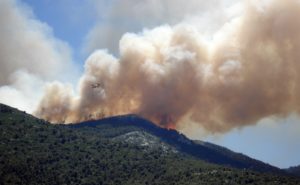
 The Joint Research Centre of the European Commission recently published the 20th edition of its annual report on forest fires, revealing that 400.000 hectares burned in the EU in 2019. A figure that needs to be nuanced: if it is twice more than in 2018, the year 2019 is among the least bad years in terms of surface hit since 1980 thanks to better reaction.
The situation in protected areas is however alarming, with 50% of forest fires in 2019 occurring in Natura2000 sites. Romania in the first place, followed by France and Italy, were the most affected countries in terms of protected sites damaged by the flames (Spain, Portugal, Italy and France remain the top 4 countries in terms of hectares burnt). In Romania, forest fires were mainly due to the management of pastures with drier and warmer weather. The longest fires in the country also happened in mountainous areas, with difficulties of access for forest protection units. In France, the Pyrenees have also been hardly hit by fires while in Italy 24% of fires occurred in mountainous areas.
43% of Natura2000 sites in Europe are located in mountainous areas. Our regions are unique biodiversity sources but are at the same time particularly vulnerable to forest fires due to land abandonment and climate change.
How EU policies can address forest fires in the next decade?
These new findings call for a better management of forests in mountain areas. Beyond the increase of surfaces, it is crucial to develop knowledge on climate change and forests’ protection as well as to promote an integrated and preventive approach to natural hazards management.
The European Commission should present in the first quarter 2021 a new EU Forest Strategy for 2030, which is expected to fix new objectives in terms of forest protection in light of climate change and resilience to forest fires. The European Commission recently published a roadmap on this Strategy, on which you can provide feedback until December 4, 2020. A more detailed consultation should also open at the end of 2020.
17 November 2020


