
• fr
  • en

Mountains still on the sidelines in policies, says the European Committee of the Regions

Mountain areas do not receive sufficient specific consideration, concludes the European Committee of the Regions in the recently adopted opinion “Enhancing Cohesion Policy support for regions with geographic and demographic handicaps (Art. 174 TFEU)”.

Drafted by Ms Maupertuis, President of the Regional Assembly of Corsica and member of the EU Committee of the Regions, the opinion stresses that efforts have been made to better respond to the constraints of the territories covered by article 174 of the European treaties – this article specifies that the Union shall pay a specific attention to regions which suffer from severe and permanent natural or demographic handicaps such as mountain, islands or cross border regions. In particular, the European Committee of the Regions welcomes the momentum offered by the launch of the Long-Term Vision for Rural Areas and the Rural Pact, the activities carried out through the Interreg programmes or macro-strategies such as EUSALP and the opportunities created by the new Policy Objective 5 of the 2021-2027 Cohesion Policy, which supports place-based initiatives in regions.


Not enough earmarked support in the new Cohesion Policy

Despite these efforts, the European Committee of the Regions’ opinion stresses that the policy measures implemented are still not sufficient to reduce the gap between the mountains and the other territories. The institution in particular notes the absence of earmarking of funds for Article 174 areas in the new programming period.

As stressed by Euromontana during the stakeholder consultation organised in May 2022 by Ms Maupertuis, the opinion also stressed that it is essential that mountain areas are not left behind in the implementation of Policy Objectives 1 and 2 of the new Cohesion Policy. 60% of Cohesion Policy funds have indeed been earmarked for these two objectives, for smarter and greener Europe.

Furthermore, as often pointed out by Euromontana and highlighted in G. Carbone’s report, there is still a gap between the programming of the Cohesion Policy and its effective implementation. Although partnership agreements and operational programmes take mountains into account, this is not systematically the case of funded actions, as demonstrated for example by the low number of CLLDs or ITIs in mountains in recent years.


Mountain challenges poorly addressed in other policies
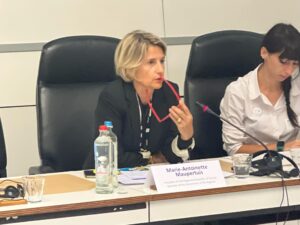
Ms Maupertuis recently shared her recommendations for a better consideration of mountain’s specific challenges at Montana174’s conference. During the event, she stressed that in addition to article 174 of EU treaties, article 175 specifies that the particular attention given to territories facing constraints should not only be given through the Cohesion Policy but also through all other European policies. This would be in line with the approach of integrated development, supported by the Long-Term Vision for Rural Areas.

Yet, Ms Maupertuis’ opinion points out the lack of consideration given to mountains for instance in mobility, energy, or competition policies. The same conclusions were drawn by Stefano Sala during the XII European Mountain Convention, where the study on mountain governance of Unimont – University of the Mountains was presented. The study demonstrates that mountain areas are usually considered in national policies related to agriculture, services, or tourism but very rarely in policies in favour of digitalisation, education, tax exemptions or research and innovation.

Euromontana welcomes Ms Maupertuis’ opinion to the European Committee of the Regions and is pleased to note a strong alignment with our own, long-held positions on the implementation of the cohesion policy in mountain areas. These observations should serve to alert mountain territories to the benefits of using certain tools and funds in the new programming period to make sure they are not left behind but should also help avoid repeating these mistakes in the post-2027 period. For more information on how to use the funds and tools of the Cohesion Policy in the mountains, you can consult the factsheets of Montana174.

Share
13 December 2022

Euromontana sur Facebook

6 days ago

Euromontana
❄️ Winter may seem to have arrived, but climate change is shortening the season and making snowfall less reliable...leaving mountain resorts with a stark choice: close or adapt?⛰️ Head to Austria to discover how the Sankt Corona ski resort has responded to this challenge and turned a climate risk into a regional asset, as part of the Interreg Alpine Space - TranStat project: www.euromontana.org/sankt-coronas-response-to-climate-change-diversifying-tourism-for-a-resilient...👉 Explore our good practices database: www.euromontana.org/good-practices-database/ Photo credits © Wexl Arena St. Corona am Wechsel ... See MoreSee Less
View on Facebook

4 weeks ago

Euromontana
🎄𝗘𝘂𝗿𝗼𝗺𝗼𝗻𝘁𝗮𝗻𝗮 𝘄𝗶𝘀𝗵𝗲𝘀 𝘆𝗼𝘂 𝗺𝗼𝘂𝗻𝘁𝗮𝗶𝗻𝒔 𝗼𝗳 𝗵𝗮𝗽𝗽𝗶𝗻𝗲𝘀𝘀 𝗳𝗼𝗿 𝟮𝟬𝟮𝟲🎅 After a year full of events, encounters, political challenges and new collaborations, it is time for the secretariat to take a short break. We will meet again soon in 2026 to continue our actions and make the voice of mountain areas heard by the EU! 🏔️ But in the meantime, let's take a step back and look at the year 2025 before it comes to an end!This year, together we: 📃 celebrated the 30th anniversary of the Krakow Declaration, which paved the way for the creation of our network, and renewed our commitment to mountain areas 🔗 www.euromontana.org/thirty-years-on-calling-for-a-stronger-european-commitments-to-its-mountains/ 🤝 launched an Alliance for European Mountains, between elected representatives of the European Committee of the Regions and the European Parliament 🔗https://www.euromontana.org/press-release-alliance-for-european-mountains-launched-mountains-need-europe-and-europe-needs-mountains/ 👩‍🏫 collaborated on more than seven European research projects with our members and other partners all over Europe🧊 highlighted water-related challenges during this International Year of Glacier Preservation (hashtag#IYGP2025)🔗 www.euromontana.org/european-manifesto-for-a-governance-of-glaciers-and-connected-resources/👋 welcomed new members, including from Montenegro and Italy🌱 visited initiatives across Europe promoting resilience in our mountain territories, through research projects or by hosting our board of directors in Trento (Cooperazione Trentina) and Krakow (Małopolska)• and much more!Thank you to all our partners, members and friends of Euromontana for this wonderful year! ... See MoreSee Less
View on Facebook

4 weeks ago

Euromontana
⏮️ Last week, on 11 December, we celebrated International Mountain Day, established in 2002 by the United Nations to remind us of the role mountains play in many aspects of sustainable living 🌱 On this occasion, we were featured in an article by the Food and Agriculture Organization of the United Nations (FAO) Liaison Office with the European Union alongside other EU regions, sharing our vision of what mountains mean to their people, cultures, and economies 🏔️ 🗣️ Our "voices form a vivid mosaic—a portrait of landscapes that shape identity, heritage, and sustainable futures."Have a look 👉https://www.fao.org/brussels/news/news-detail/international-mountain-day--voices-from-the-peaks/en ... See MoreSee Less
View on Facebook

4 weeks ago

Euromontana
👩‍🌾 We are currently attending the EU Agri-Food Days, organised by the European Commission and DG AGRI, which are taking place in Brussels over the course of three days!We heard from the president of the European Commission Ursula von der Leyen and the European Commissioner for Food and Agriculture, Christophe Hansen, and attended numerous high-level political sessions with stakeholders in the sector 🗣️ The agenda included discussions on achieving a robust and contemporary CAP to ensure food security across the EU, establishing fair remuneration schemes within the food chain, and fostering a resilient agri-food sector 👩‍🌾 🌱 Euromontana will continue to play an active role in promoting a future CAP that benefits those most in need and supports the territorial development of rural areas in the face of climate change and generational renewal challenges 🏔️ 👉 Read our policy position on generational renewal within the CAP and our other contributions to the next European budget: www.euromontana.org/meeting-the-challenges-of-generational-renewal-shaping-the-future-of-mountain... EU Food & Farming ... See MoreSee Less
View on Facebook

1 month ago

Euromontana
🧊 Glaciers matter for water, food and livelihoods in mountains and beyond. This is what we are highlighting this year on 11 December, International Mountain Day.Every year, this day provides an opportunity to emphasise the crucial importance of these areas in terms of natural resources, biodiversity, identity, cultural heritage, ways of life, and more resilient models. However, all of this is under threat from climate change, poorly targeted funding and negative perceptions of pastoral professions.Today, we are putting the spotlight on these endangered ice giants throughout our mountain ranges!Did you know that: 💧The Alps alone provide 40% of Europe's fresh water?💡Glacier retreat will reduce hydroelectric energy production by an average of 10% in the Alps and by up to 35% by 2070 compared to today?🌱68% of irrigated agricultural land in the plains depends directly on water runoff from the mountains? ⛰️By 2034 the Pyrenees will be ice-free?📢An appropriate governance of glacier is needed to counteract the rapid changes!🧊 By signing the manifesto for better European governance of glaciers alongside 80 other organisations, we are calling for immediate and targeted political responses to the economic, social and environmental impacts of climate change.Have a look 👉 www.euromontana.org/european-manifesto-for-a-governance-of-glaciers-and-connected-resources/ #IMD2025 #InternationalMountainDay #MountainsMatterMountain Partnership ... See MoreSee Less
View on Facebook

Euromontana sur Twitter