



Why do we need a study on the circular economy in mountain forestry?
Euromontana is delighted to present its study entitled: Innovation and Circular Economy in the Mountain Forest Supply Chain: How to Close the Loop? The circular economy is based on “sharing, leasing, reuse, repair, refurbishment, and recycling” of products and materials in an ideally closed loop” The necessity for a more circular economy will only increase with increasing pressure on and decreasing availability of natural resources.
This study focuses specifically on the circular economy in mountain forestry. The adoption of the circular economy will be particularly important in mountain areas which contain exceptional primary resources such as forests, water, and minerals, and provide ecosystems services such as carbon sequestration, clean water, landscapes, and recreation. Maximizing the value of extracted resources and managing them sustainably, two foundations of a circular economy, is particularly important for maintaining a high quality of life in mountain territories.
Objectives and outline of the study
The study has four objectives: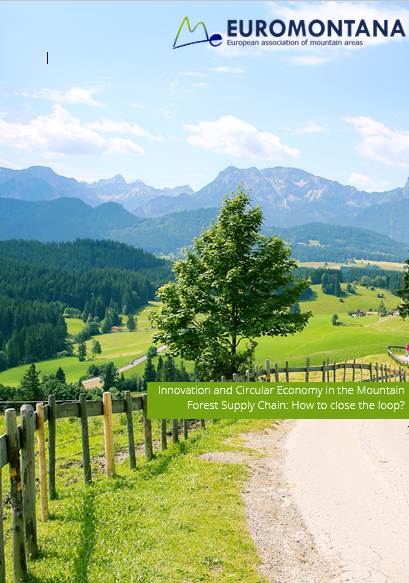
- better understand the policy framework supporting the circular economy;
- explore visions for a circular economy all along the mountain forest supply chain;
- present tools, instruments, and processes to improve the circular economy in forestry; and
- provide examples of experiences and good practices, ideas and proposals.
The study is divided into two parts. Part 1 presents the concept of the circular economy, its potential application in forestry, with a focus on the mountain forest supply chain, and the circular economy at the EU level. Part 2 presents a series of good practices in innovation and circular economy in mountain forestry to show how the concepts presented in Part 1 may be applied in practice. The good practices were collected from Euromontana members such as SAB, CIA, ERSAF, Hedmark County Council, and PINS, as well as local governments, nonprofits, universities, and businesses.
The study builds on the November 29, 2016 Euromontana workshop by the same name, Innovation and Circular Economy in the Mountain Forest Supply Chain: How to Close the Loop?, organized in collaboration with member organization PINS, a Croatian local development agency based in Skrad, Croatia and with the support of Croatian MEP, Jozo Radoš, from the RUMRA (Rural, Mountainous and Remote) intergroup. The presentations and the discussions from the workshop have informed the content of the study as well as the recommendations presented in brief below and in full in the study Conclusions.
Recommendations
Euromontana proposes the following recommendations to promote the circular economy in forestry and mountain areas. The recommendations are outlined in greater detail in the study.
We recommend:
- That the European Commission develop more applied research and innovation on circular economy both in general and more specifically in the forest sector.
- That funding be provided for SMEs so that they can adapt their businesses to align with circular economy principles.
- That local actors seize the opportunity to participate in EIP-AGRI Operational Groups addressing address circular economy issues and to develop new Operational Groups specifically on the circular economy in forestry.
- That dialogue be reinforced between all actors of the value chain.
- That Member States integrate specific support, funding and actions for the circular economy in the forest sector and in mountain areas into their national plans on the circular economy.
- That the EU, Member States, and regions work together to develop an integrated territorial approach for the adoption of the circular economy, including inviting local stakeholders to the table.
- That the European Commission develop a platform to share good practices in the circular economy. The European Commission recently announced a Circular Economy Finance Support Platform. We hope that the platform will help in achieving this recommendation.
- That Euromontana contribute to the above effort and collect and share good practices and exchange experiences in the circular economy in mountain areas, including for the forestry sector.
- That universities and training institutions, especially our members in mountain areas, develop adapted educational programmes to educate students and professionals about the circular economy in mountain areas.
- That the market be stimulated in ways that promote the circular economy, encourage the use of wood more generally in the market, and specifically encourage the adoption of the circular economy in the forest sector, for example through sensibilization and awareness raising
If adopted, these recommendations could help promote the circular economy in forestry and in mountain areas more generally. Euromontana will continue to work towards the transition to a circular economy in mountain areas in order to promote living mountains for current and future generations.
To learn more, we encourage you to read the study and especially the recommendations therein. The study can be found at this link. Do not hesitate to share this study widely.
23 March 2017


