




Region Podkarpackie is situated in south-eastern part of Poland. Its administrative capital and largest city is Rzeszów. It is one of the most eastern regions of the European Union. Region Podkarpackie shares borders with countries such as Ukraine and Slovakia as well as with the Polish regions of Małopolskie, Świętokrzyskie and Lubelskie. Region Podkarpackie covers an area of over 17,800 square kilometres and has a population of over 2 million people.
The executive body of the region’s self-government (or of the local government or of the Podkarpackie local government) is the Regional Executive Board, which consists of 5 persons and includes the marshal of the region (as chairman), 2 deputy marshals (vice-chairmen) and 2 board members. Since May 2013, the head of the region (Marshal of Region Podkarpackie) has been Mr Władysław Ortyl. Along with the Marshal, the region is governed by the Podkarpackie Regional Assembly (regional parliament).
It is a region with a rich history, extremely valuable nature, and full of wonderful monuments. The region is mostly hilly or mountainous (Bieszczady, Beskidy) apart from its north-western territory. Bieszczady Mountains are a group of two mountain ranges in the Carpathian massif, being the second largest mountain massif in Europe and covering the area of 190,000 square kilometres, including 19.6 thousand in Poland (6.3% of the country’s area). Bieszczady Mountains are located between the Vyshkovskyi Pass and Łupków Pass. The highest peak on the Polish territory is Tarnica (1346 m). Bieszczady are divided into a Western side (on the territory of Poland and Ukraine) and an Eastern side (on the territory of Ukraine). Bieszczady belong to the Eastern Beskids, which are part of the Outer Carpathian Mountains. The most interesting viewpoints include: Tarnica, Połonina Caryńska Połonina Wetlinska and Wielka Rawka.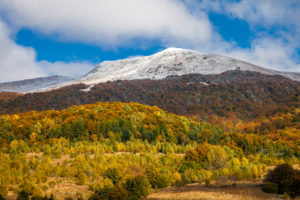
It is one of the most wooded Polish regions. Within its borders there is the whole Bieszczady National Park, as well as part of the Magura National Park. The specific location of Region Podkarpackie is it a great asset, and the quality of nature and the environment make it one of the most popular destination for tourists in Poland, mainly due to the beauty of its landscape and cultural heritage. Bieszczady Mountains have an incredible charm, attracting crowds of tourists who want to rest in the surrounding unpolluted nature.
There is a network of over 130 km hiking trails in the Bieszczady National Park, which creates excellent conditions for close contact with nature for wildlife enthusiasts. The Magura National Park also offers many unique flora and fauna species. Protected species of the region include wolves, bears, lynx, European bison, and beavers, thanks to which educational excursions can be organised.
 In Region Podkarpackie there is a growing number of farms offering agri-tourism activities and possibilities of organic food production. The region can also boast numerous health resorts such as Iwonicz Zdrój, Rymanów Zdrój and Polańczyk. Solina Lake, the largest artificial reservoir in Poland, also provides excellent facilities for water sports or sailing schools. Horse tourism is also becoming more and more popular in Region Podkarpacie. Moreover, many religious and secular buildings, such as wooden churches, palaces and mansions have been preserved in the region.
Active leisure activities, mountain hiking and multiculturalism are accompanied by the production of innovative technologies in the aviation, IT and automotive industries. Region Podkarpacie hosts the Aviation Valley. The modern Rzeszów/Jasionka airport, with an international passenger and cargo terminals, facilitates manufacturing, trade and logistics for companies operating in the region.
Aviation, IT and automotive industries as well as quality of life are considered to be four specialisations of Region Podkarpackie and determine the directions of economic growth of the region, while its natural, cultural and tourism assets contribute to making it a vibrant place to live.
16 March 2021


