



The Romanian National Mountain Council held its first meeting on 20 April 2023, under the coordination of the Prime Minister of Romania, Nicolae-Ionel Ciucă.
Created by the Romanian Mountain Law (No. 197/2018 of 20 July 2018), the National Mountain Council aims to ensure cooperation between the government and mountain representatives in the drafting and implementation of specific strategies and policies. The creation and launch of the National Mountain Council is an important step for the future of the mountains in Romania, as it aims to ensure that future public policies contribute to sustaining the population and supporting the local economy. The National Mountain Council also allows for connections between national policies and local realities, by consulting and monitoring the activities of the 9 Massif Committees.The secretariat for the Massif Committees and the National Mountain Council is provided by the National Agency of the Mountain Area.
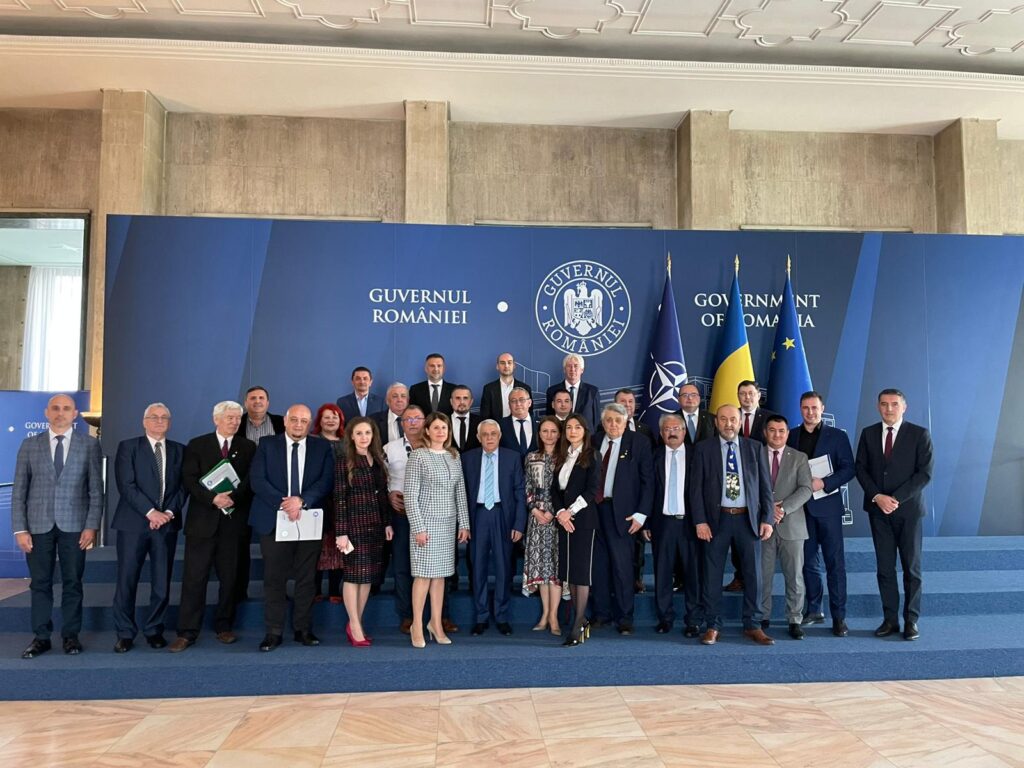
The meeting was attended by the Prime Minister, Nicolae-Ionel Ciucă, the Minister of Agriculture and Rural Development, Petre Daea, representatives of the National Agency for Mountain Areas and members of the National Mountain Council: State Secretaries of the Ministries of Agriculture, Health, Economy, Internal Affairs, Development, Education, Environment, representatives of the Prime Minister’s Office, the National Health, Veterinary and Food Administration and the National Food Safety Authority, the chairmen of the mountain committees, representatives of the economic, academic and associative sectors and the manager of the hunting fund.
 During this first meeting, participants discussed the main needs and problems of mountain areas. The Presidents of the 9 Mountain Committees shared the main problems identified at local level and proposed public policies or legislative changes in the field of protection and sustainable development of the mountain area and investment programmes.
Discussions during the National Mountain Council meeting resulted in the identification of several needs on the part of mountain stakeholders:
- Improve coherence between legislations on health, veterinary, tourism, environment, agriculture and rural development and education;
- Improve legislation with provisions to regulate motorised traffic in mountain areas and protected areas (damage to forests, pastures, public and private property, damage to biodiversity and the mountain landscape, etc.);
- Amend the current environmental legislation on hunting to reduce pollution, to repopulate rivers with certain species of fish and to find solutions to protect farmers and tourists from wild animals;
- Provide further support to mountain communities;
- Encourage the classification of mountain areas as eco-tourism destinations.
About the Romanian Mountain Law
The 2018 Mountain Law valorises the assets of the Romanian mountain areas and provides a legal framework for their sustainable development. Following the adoption of the law, 9 Massif Committees were created in 2019. Their aim is to promote cooperation between stakeholders within each massif and to make recommendations to the national authorities.
Several Romanian members of Euromontana are part of the National Mountain Council and have long been advocating for policies and a governance model that takes better account of mountain areas.
14 June 2023


