



Branding and labelling mountain products answer various needs: clarification for consumers, protection of producers and promotion of traditional know-hows and local identities. Territorial brands are thus flourishing, including in the Alpine region. To better understand these initiatives and their governance but also to foresee challenges ahead, the EUSALP Action Group 6, sub-group 2 “Future-oriented farming and forestry” organised the Workshop on “Territorial Brands in the Alpine Region”, in Bolzano, Italy, on May 13 2019.
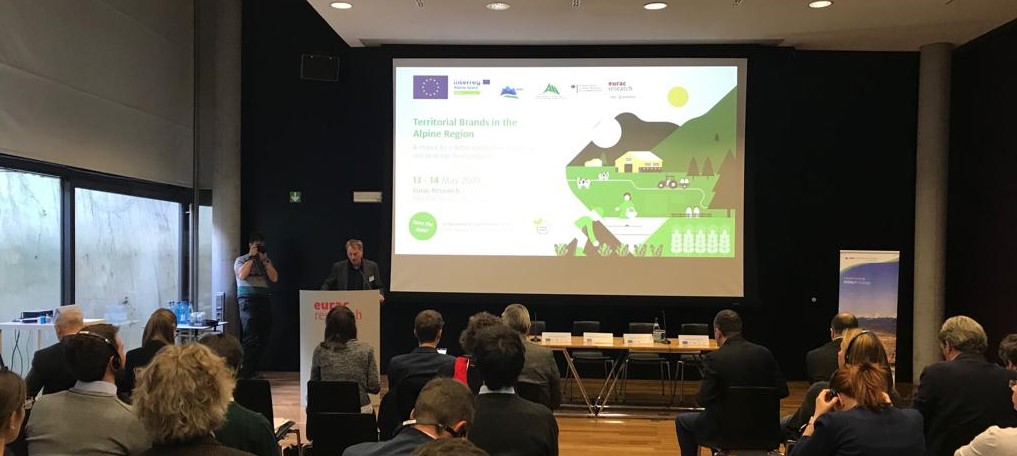
The meeting compared several ongoing experiences of territorial brands, to raise the awareness on valorising mountain products and to discuss actual trends among practitioners. Different sessions were organised to better understand the scope of these territorial brands. To start with, initiatives from the Alpine region, focusing on the processes of involvement of operators were presented. In this session different cases were presented, such as Bohinj (SL), Rote Hann (IT), Valis Wallis promotion (CH), AFTAlp (FR), 100% Valposchiavo (CH), Marque Savoie (FR).
Apart from producers and operators, political institutions can also play a crucial role in the promotion of mountain products. In this regard, Euromontana presented the institutional work carried out since the 1990’s to obtain a European protection of mountain products. The implementation of the optional quality term “mountain product” in different European Member States was also analysed, with various implementation levels from one country to another. While Italy and Romania, for instance, created a dedicated national logo for consumers to better identify mountain products, other countries such as Spain and Croatia have not yet implemented the European legislation. Other institutional initiatives were presented, such as the coordination of 70 local brands in Germany by the Bavarian Ministry of Agriculture, Food and Forestry or the initiative from the Metropolitan City of Turin to experience a basket of typical products of the province of Turin.
The last session aimed at discussing ways to measure the economic, social, cultural and environmental impact of Territorial Brands and how they can support the development of the territory. The meeting enabled Alpine stakeholders to compare measures that are being developed to promote mountain products. Branding and labelling give importance to different aspects: local consumers’ and tourists’ expectations, the search for quality in the processes and in the products, the definition of a territorial quality which would systemise all certified products, and reflect the complexity of local identities, global and non-sectoral languages and approaches, the difficulty of bringing together local brands and brands from large regions.
Discussions led to the identification of core points for future attention:
- Future new targets: Alpine territories and products must start to think about communicating with young people as the youth needs an adequate language to tell things that may interest them. New tourists from oriental regions is also a target to think about, as they have a different vision of the Alpine identity than mainstream tourists.
- Local identity: brands are based on traditional know-hows of local communities. Their ability to express their identity is a key factor for the success of the brand. Human capital in the capacity of expressing a specific identity deserves a particular attention and raises demand for trainings.
- Balance of the promotion efforts: certification processes and communication through the management of a brand are expensive activities. Finding the right and fair balance between the needs of a community in terms of identity and what it takes to promote it should be further discussed.


