



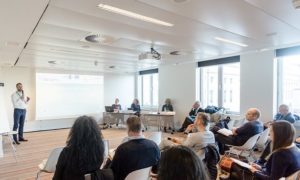
During the European Week of Regions and Cities, on October 10, 2019, a session was organised by DG AEC (Education, Youth, Sport and Culture) and ESPON, to help understand the economic impact of material cultural heritage.
This session aimed at resuming the work carried out by ESPON during the past year on the HERITAGE research project (The Material Cultural Heritage as a Strategic Territorial Development Resource: Mapping Impacts Through a Set of Common European Socio-economic Indicators). Concluded in July 2019, the HERITAGE project came out with a report highlighting the economic benefits of material cultural heritage in different countries, including mountainous ones such as Norway, Romania, Slovakia, Slovenia and Austria. Studied sites include all sites with recognised heritage value whether or not legally protected by national or international legal frameworks.
The main outcomes of the study show an important economic impact of material cultural heritage on different sectors, such as tourism and construction work. In the studied countries, material cultural heritage is for instance believed to represent 2.1% of total employment and 1% of the total economic turnover.
Within these statistics, gaps exist of course between countries. The tourism sector is an interesting example, with attractivity depending on the reputation of cultural heritage sites. In Italy and Austria, respectively 42% and 18% of the total economic turnover of the tourism sector is linked to the countries’ cultural heritage sites. If the rate is lower in other countries such as Romania and Slovenia, economic benefits of cultural heritage on the tourism sector is constantly increasing too.
 ESPON’s HERITAGE project provides interesting data which can help sustainably manage material cultural heritage in mountainous areas, specifically where these sites attract a high number of tourists and could lead to over tourism practices. Researchers however pointed out the difficulty to assess the impacts of material cultural heritage on other economic sectors, which could have been of a great interest for mountain regions, such as crafts.
The European Commission also presented the European framework for action on cultural heritage and reminded the success of the European Year of Cultural Heritage in 2018, with more than 37 countries involved and 14.000 labelled events organised. During the European Year of Cultural Heritage Euromontana organised in September 2018 the XI European Mountain Convention in Vatra Dornei, Romania. To close this bi-annual event, a declaration was signed by participants, calling for a better recognition of mountains’ cultural and natural heritage – assets which cannot be relocated, rooted in mountain’s identity and which highly contribute to the attractiveness and innovation potential of our territories.
Cultural and natural heritage is a crucial issue in mountain areas, not only regarding economic impacts but also for the preservation of natural landscapes and traditional know-hows for instance. For inspiring examples on how to enhance mountains’ cultural heritage, please consult Euromontana’s booklet of good practices . You can also read about the recently launched request to include transhumance on the UNESCO list of Intangible Cultural Heritage.
6 November 2019


