
• fr
  • en

The brown bear reappears in Portugal after almost two centuries

Biodiversity has recently been in the spotlight mainly due to news about biodiversity loss and species going extinct (see the latest IPBES Global Assessment report published on 06/05/2019).

But for the first time since 1843, a brown bear has been spotted in Portugal, where it is officially considered extinct by the IUCN. It was a beekeeper in the Montesinho Natural Park, Bragança (northwest Portugal) who noticed the bear’s presence after it damaged his beehives. The beekeeper informed the Institute of Conservation of Nature and Forests (ICNF), which in turn sent experts to examine the site and take samples of footprints, fur, and scats. Based on this evidence, the ICNF confirmed the news.

Male bears can wander for long distances in search for food and new territories. The bear sighted in Portugal probably comes from the western population of the Cantabrian Mountains (Spain). There, the brown bear population has increased to around 280 individuals at present according to the Spanish Fundación Oso Pardo. During the past few years males from the Cantabrian Mountains have occasionally been observed wandering along the Spanish – Portuguese border. In the transboundary collaboration, the ICNF and Spanish conservation authorities monitor the movements of bears as these spread into new territories.
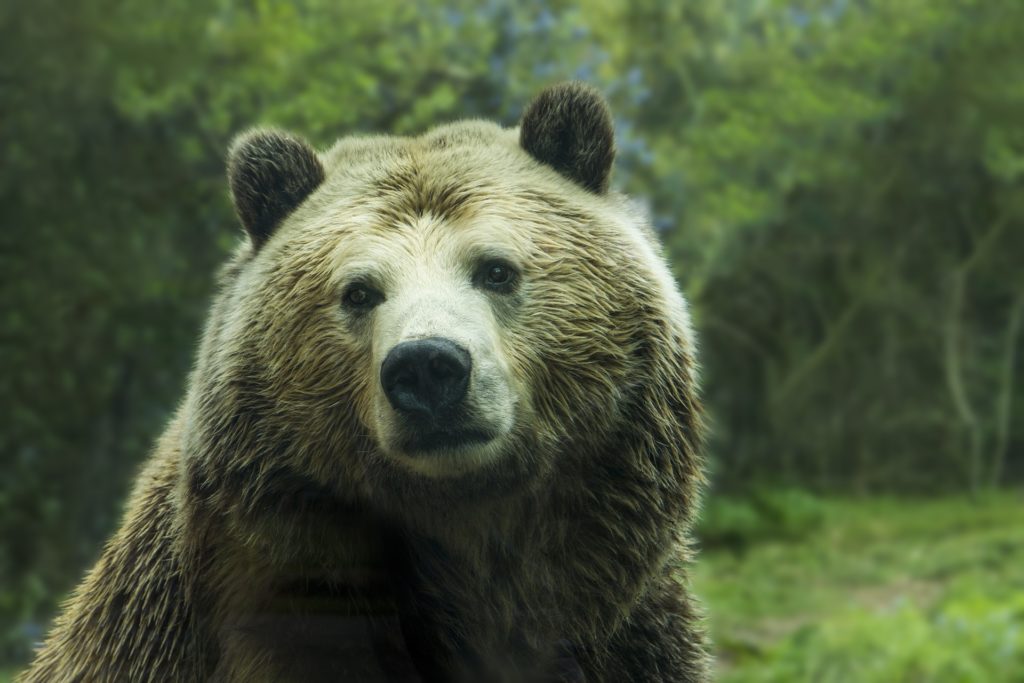
The brown bear’s return in Portugal is important for multiple reasons. Firstly, the bear is part of the Portuguese natural and cultural heritage, and the public reacted with great excitement to the sighting. Secondly, the scientific aspect is important as well. As a Euromontana member João Azevedo from Centro de Investigação de Montanha says, it is interesting to “see how bears will use the habitat and landscape, and how the ecosystems and landscapes will be affected. It is important also in the analysis of depopulation-abandonment-rewilding of mountains in Portugal and other parts of Europe”. Depopulation and land abandonment have many negative effects, such as an increase in forest fires. But there are also positive aspects, such as an increase in ecosystem services and the return of iconic wildlife species like bears. This is linked to the third aspect – economic opportunities. As many European citizens are interested in bears, Portuguese mountain communities can use such interest to generate sustainable incomes through, for instance, bear-watching, or creating product labels and brands from bear territories.

However, for the time being it is just one bear, and Portuguese experts are unsure whether a stable bear population is possible in Portugal. Bears require large areas of continuous habitat for food and shelter. In fact, the bear’s extinction in Portugal was driven by land cover change and habitat fragmentation. In addition, potential bear habitats need to offer enough natural food sources to avoid bears from approaching human settlements in search for food like beehives or garbage. As currently only a framework exists on wolf damage evaluation and compensation in Portugal, the ICNF recommends using electric fencing to protect the beehives until further knowledge is available on the bear presence in the area.

Euromontana will continue to monitor the situation and keep you informed about future developments.

Share
23 May 2019

Euromontana sur Facebook

4 weeks ago

Euromontana
❄️ Winter may seem to have arrived, but climate change is shortening the season and making snowfall less reliable...leaving mountain resorts with a stark choice: close or adapt?⛰️ Head to Austria to discover how the Sankt Corona ski resort has responded to this challenge and turned a climate risk into a regional asset, as part of the Interreg Alpine Space - TranStat project: www.euromontana.org/sankt-coronas-response-to-climate-change-diversifying-tourism-for-a-resilient...👉 Explore our good practices database: www.euromontana.org/good-practices-database/ Photo credits © Wexl Arena St. Corona am Wechsel ... See MoreSee Less
View on Facebook

2 months ago

Euromontana
🎄𝗘𝘂𝗿𝗼𝗺𝗼𝗻𝘁𝗮𝗻𝗮 𝘄𝗶𝘀𝗵𝗲𝘀 𝘆𝗼𝘂 𝗺𝗼𝘂𝗻𝘁𝗮𝗶𝗻𝒔 𝗼𝗳 𝗵𝗮𝗽𝗽𝗶𝗻𝗲𝘀𝘀 𝗳𝗼𝗿 𝟮𝟬𝟮𝟲🎅 After a year full of events, encounters, political challenges and new collaborations, it is time for the secretariat to take a short break. We will meet again soon in 2026 to continue our actions and make the voice of mountain areas heard by the EU! 🏔️ But in the meantime, let's take a step back and look at the year 2025 before it comes to an end!This year, together we: 📃 celebrated the 30th anniversary of the Krakow Declaration, which paved the way for the creation of our network, and renewed our commitment to mountain areas 🔗 www.euromontana.org/thirty-years-on-calling-for-a-stronger-european-commitments-to-its-mountains/ 🤝 launched an Alliance for European Mountains, between elected representatives of the European Committee of the Regions and the European Parliament 🔗https://www.euromontana.org/press-release-alliance-for-european-mountains-launched-mountains-need-europe-and-europe-needs-mountains/ 👩‍🏫 collaborated on more than seven European research projects with our members and other partners all over Europe🧊 highlighted water-related challenges during this International Year of Glacier Preservation (hashtag#IYGP2025)🔗 www.euromontana.org/european-manifesto-for-a-governance-of-glaciers-and-connected-resources/👋 welcomed new members, including from Montenegro and Italy🌱 visited initiatives across Europe promoting resilience in our mountain territories, through research projects or by hosting our board of directors in Trento (Cooperazione Trentina) and Krakow (Małopolska)• and much more!Thank you to all our partners, members and friends of Euromontana for this wonderful year! ... See MoreSee Less
View on Facebook

2 months ago

Euromontana
⏮️ Last week, on 11 December, we celebrated International Mountain Day, established in 2002 by the United Nations to remind us of the role mountains play in many aspects of sustainable living 🌱 On this occasion, we were featured in an article by the Food and Agriculture Organization of the United Nations (FAO) Liaison Office with the European Union alongside other EU regions, sharing our vision of what mountains mean to their people, cultures, and economies 🏔️ 🗣️ Our "voices form a vivid mosaic—a portrait of landscapes that shape identity, heritage, and sustainable futures."Have a look 👉https://www.fao.org/brussels/news/news-detail/international-mountain-day--voices-from-the-peaks/en ... See MoreSee Less
View on Facebook

2 months ago

Euromontana
👩‍🌾 We are currently attending the EU Agri-Food Days, organised by the European Commission and DG AGRI, which are taking place in Brussels over the course of three days!We heard from the president of the European Commission Ursula von der Leyen and the European Commissioner for Food and Agriculture, Christophe Hansen, and attended numerous high-level political sessions with stakeholders in the sector 🗣️ The agenda included discussions on achieving a robust and contemporary CAP to ensure food security across the EU, establishing fair remuneration schemes within the food chain, and fostering a resilient agri-food sector 👩‍🌾 🌱 Euromontana will continue to play an active role in promoting a future CAP that benefits those most in need and supports the territorial development of rural areas in the face of climate change and generational renewal challenges 🏔️ 👉 Read our policy position on generational renewal within the CAP and our other contributions to the next European budget: www.euromontana.org/meeting-the-challenges-of-generational-renewal-shaping-the-future-of-mountain... EU Food & Farming ... See MoreSee Less
View on Facebook

Euromontana sur Twitter