



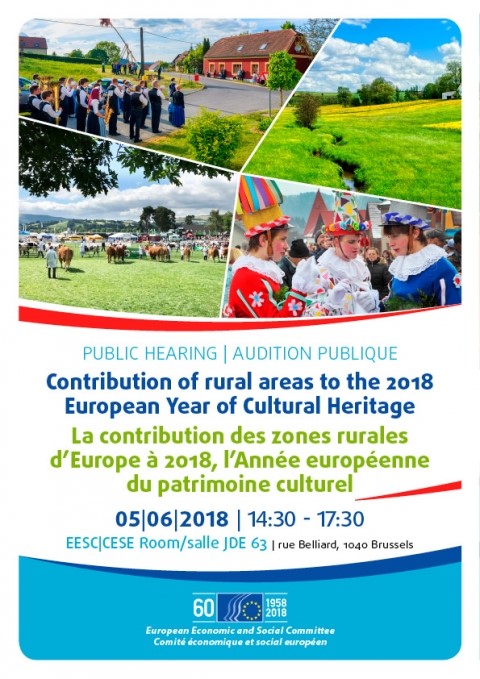
 Within the framework of the European Year of Cultural Heritage (EYCH), the European Economic and Social Committee (EESC) organised on 5th June 2018, a public hearing to discuss the opportunities that this European Year envisages for rural areas and how rural areas can contribute to this year.
The meeting aimed to take stock of what has been achieved and what remains yet to be done and to learn how to build upon the experience and views of relevant stakeholders and players in the cultural heritage domain.
The outcome and conclusions of the hearing were mainly useful to provide relevant inputs into the preparation of the EESC opinion on the “Contribution of Europe’s Rural Areas to the 2018 Year of Cultural Heritage”. The current working document, whose rapporteur is Tom Jones, focuses on the huge assets and talent that rural areas and their citizens have and how they contribute to Europe’s cultural heritage. The draft opinion based on the working document should be available by 24th July and it should be adopted in plenary EESC session by 19th – 20th September 2018.
Euromontana welcomes the initiative to draft such opinion and suggested some improvements of the current working document to better emphasize the mountain cultural heritage:
1. The draft opinion mentions the concept of rural-proofing many times but does not define it. Euromontana would like to have a clear definition of what “rural-proofing” means for cultural heritage policy and how it can concretely be apply.
2. Euromontana recommends doing better linkages between natural and cultural heritage, these links being of particular importance in rural areas. Thus, it encourages to use the term of “cultural landscapes” showing the interactions between natural resources and human activities to maintain landscapes.
3. The draft opinion states that “the contribution of farm open days, school rural visits, shows, fairs and cultural festivals deserve public funding support as do measures to build bridges between rural and urban citizens through cultural projects.” Euromontana would like to add that they should also help urban citizens to better understand rural areas and their interconnections with urban areas and overcome “romantic vision” on rural areas as many stakeholders noticed during the public hearing.
4. Euromontana welcomes the proposal to have a better marketing of PGI (Products with Geographical Indication) and also encourages a better valorisation of quality products in general including with the new optional quality scheme on mountain products, especially because tourists look more and more for authenticity.
5. The draft opinion never mentions the new Smart Villages concept, while Euromontana strongly supports its implementation with social and technological innovation, in particular in the more remote, mountainous and sparsely populated areas where cultural heritage can be a decisive factor to regain attractiveness.
6. As a last comment, Euromontana also highlighted the need for developing high speed broadband and ICT trainings, especially on affordable or free ICT tools that could be easily used by small and medium sized business in rural areas.
In addition, Euromontana also shared some examples of projects and events that valorise the mountain cultural heritage, such as the Alpine Space project YOUrALPS which reconnect youth and mountain heritage through education and others which will be presented during the European Mountain Convention on Cultural Heritage as an Engine for Creativity, Innovation and Socioeconomic Development for the Future of Mountain areas that will take place on 25-26-27 September 2018 in Vatra Dornei, Romania. This event being a good example of the desire to use cultural heritage as a tool for sustainable development and of giving new socio-economic opportunities for the future in mountain areas.
The presentations of the public hearing are available here
20 June 2018


