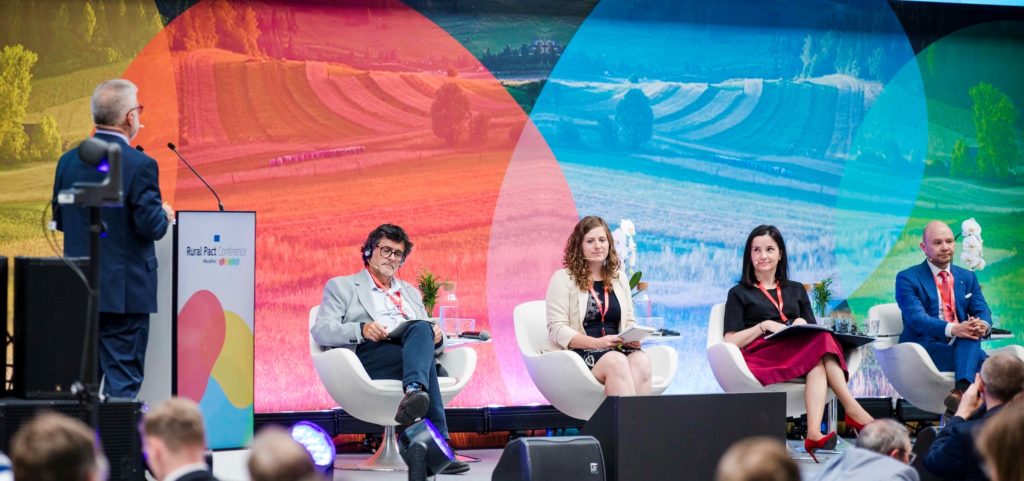
Euromontana can help delivering on the Rural Pact. This was the message from our President Juanan Gutierrez at the Rural Pact conference in Brussels last 15 and 16 June.
The Rural Pact is one of the two main components of the Long-Term Vision for Rural Areas. On the one hand, the Action Plan compiles the European Commission’s actions to make rural areas stronger, more resilient, connected, and prosperous. On the other hand, the Rural Pact is a framework for cooperation among authorities and stakeholders at the European, national, regional and local level. The Rural Pact should for instance encourage the uptake of the rural proofing concept at all levels and promote the exchange of knowledge and inspirational good practices between rural territories.
The June conference aimed at launching the Rural Pact by encouraging stakeholders to engage in the Rural Pact Community and making commitments towards its success.

Euromontana’s contribution to the Rural Pact
As a multi-disciplinary, multi-sectoral network of mountain stakeholders, Euromontana has been actively collecting and disseminating knowledge and good practices across Europe for several years. The spirit and objectives of the Rural Pact are therefore part of Euromontana’s DNA, this why we intend to contribute to the Rural Pact by committing to:
- Integrate the objectives of the Rural Pact in the network’s activities whenever possible, for example when organising events, including the European Mountain Conventions
- Encourage our members to join the Rural Pact Community and submit their commitments at local or regional level for their mountain area
- Disseminate among our members inspirational good practices collected within the Rural Pact Community
- Bring the voice and experiences of mountain communities within the Rural Pact Community
Uncertainties remain on the implementation of the Rural Pact
Euromontana welcomes the Rural Pact initiative and is eager to engage actively in the Community. Yet, Euromontana has some concerns about the concrete scope and functioning of the Rural Pact and therefore its capacity to federate all rural stakeholders.
As regard to the scope of the Rural Pact Community, Euromontana regrets it is seemingly not open to European rural stakeholders from non-EU countries. Other countries, such as Norway, Switzerland or the Balkan countries may have a lot to contribute to the Rural Pact Community, bringing different political contexts and inspiring experiences.
In terms of mission, Euromontana strongly calls on the Coordination Group – which should start operating from early 2023 – to concretely connect both components of the Long-Term Vision for Rural Areas, namely the Rural Pact to the Action Plan. Their implementation, in terms of priorities and tools, must go hand in hand.
Moreover, when it comes to the structure of the Coordination Group, Euromontana recommends the creation of a number of thematic clusters addressing specific challenges, as a way to encourage actual engagement better structure the way stakeholder commitments are processed. An example of such structure is the EU’s Smart Cities Marketplace, such thematic clusters could be initiated and supported by the Coordination Group based on the needs of the Rural Pact Community (as expressed through the commitments submitted) and evolve over time. In addition, Euromontana calls for the inclusion in the Coordination Group of members representing territories with geographic specificities – such as mountains, islands, cross border regions – as highlighted by our President during the plenary session of the Rural Pact conference.