



AgriResearch Conference 2018
 The EU AgriResearch Conference assembled over 500 people in Brussels on 2&3 May 2018 who wished to learn more about EU agricultural and rural Research & Innovation (R&I) achievements and have their say on how to shape the future of agricultural R&I after 2020. All presentations are available here.
Agricultural researchers and policy-makers face an important number of challenges such as the economic viability of smalls farms, the health of citizens, the environmental sustainability of current farming systems, the impact of climate change on food security, the economic foresight of the impact of public subsidies in the agri-food sector, the CAP legislative proposals and budget for the next EU programming period, etc. In that context, the conference objectives were:
- to take stock of the implementation of the EU agricultural Research & Innovation strategy and present its first results in terms of knowledge produced and impacts;
- to further discuss future EU agricultural and rural R&I policies, in particular the future EU framework programme for research and innovation and the future CAP by identifying key issues deserving particular attention under the different strategy priorities.
State of the art in agricultural research and innovation
Research and innovation in agriculture and rural development is funded through Horizon 2020 under Societal Challenge 2 (SC2), as well as the European Innovation Partnership on agriculture (EIP-AGRI) with the Operational Programmes and various other cross-cutting programmes. More than 1.7 billion € were attributed to H2020 SC2 over the current programming period. The figure shows the budget allocation according to thematic clusters and also demonstrates the variety of subjects covered by this research programme.
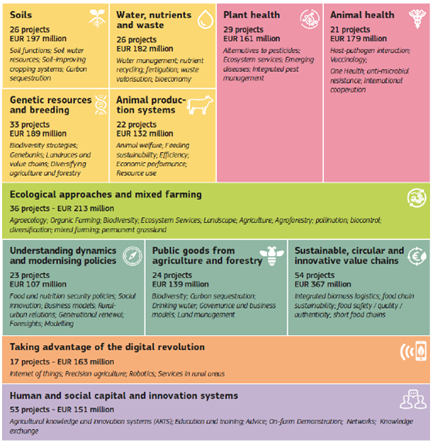 Euromontana attended a session on “Attractive, smart and resilient rural communities”. 53 projects were funded or are expecting grants covering that thematic over the 2014-2020 programming period. PEGASUS and SIMRA are two H2020 projects Euromontana has been involved in and which delivered or are delivering under this thematic, so Euromontana is particularly proud they were showcased at this major conference.
- SIMRA, standing for Social Innovation in Marginalised Rural Areas, is a four-year H2020 project (2016-2020) that aims to categorise, understand and evaluate social innovation in different settings thanks to case studies and disseminate new knowledge to policy-makers.
- PEGASUS, standing for Public Ecosystem Goods and Services from land management – Unlocking the Synergies is a three-year H2020 project (2015-2018) focusing on identifying land management practices that could enhance the provision of public goods and ecosystem services.
Other H2020 projects were also showcased alongside SIMRA and PEGASUS, namely STRENGTH2FOOD working on sustainable local food supply chains and SUFISA instigating sustainable finance for agriculture and fisheries.
The European Commission has particularly searched to develop the multi-actor approach over these past few years to encourage knowledge co-creation and inclusion of newcomers in H2020 projects and will continue to do so in the future. Over €1 billion have been used to this purpose, in funding 180 grants. Approximatively 40% of H2020 budget is nevertheless earmarked for core scientific research.
EU aims to have a R&I strategy working closely and in coherence with other EU and national policies, thus it encourages synergies (with EIP-AGRI operational groups for instance at EU-level). The AgriResearch conference also aimed at demonstrating the EU’s implementation approach of research and innovation. These can be summarised through:
- Building synergies with Member States: rural development programmes, ERA-Net, smart specialization strategies, … Horizon 2020 represents only 10% of Research & Innovation budget in the EU and thus seeks partnerships with Member States to foster knowledge transfer and capacity-building.
- Building synergies with the private sector: digital hubs, Bio-Based Industries Joint Undertaking (BBI-JU), …
- Building synergies with other European policies: Smart Villages, circular economy, LIFE, Erasmus (skills agenda), Interreg Europe (ERDF investments in digital or bio-based innovation for instance), and many more. For instance, the Interreg Europe ERUDITE project was presented during the conference which works on sustainable business models for digital service development and deployment.
- Developing international cooperation: EU-China or EU-Africa programmes
- Interactive innovation, through EIP-AGRI’s activities such as thematic networks for instance which bring people from both science and practice together to create useful and practical outputs or focus groups which bring together experts, including farmers, advisers, researchers and agri-business representatives, to collect and summarise knowledge on best practices in a specific field, listing problems as well as opportunities. Based on this, the groups identify ideas for applied research and for testing solutions in the field.
Which future to expect for agricultural research and innovation?
Prior to the AgriResearch conference, Carlos Moedas, Commissioner for research, science and innovation, invited a high-level group directed by Pascal Lamy to draw up a vision and strategic recommendations to maximise the impact of future EU R&I programmes. The LAB-FAB-APP report was published in July 2017 and provides the EC with 11 recommendations including prioritising research and innovation in EU and national budgets and adopting a mission-oriented, impact-focused approach to address global challenges. The impact aspect in particular and the EU added value of research projects were highlighted many times during the AgriResearch conference. In the future, it is probable that the political emphasis will be set on capturing and better communicating impact of research projects.
The next framework programme, referred to as FP9 up until now, will be called Horizon Europe. With a proposed budget of € 100 billion for research and innovation, the Commission has earmarked an unprecedented 10% of that amount, or € 10 billion, to go towards research and innovation in food, agriculture, rural development and the bio-economy.
With this panorama offered to the many participants present, they also had the opportunity to raise new thematic research needs or operational problems to improve the current approach. Among ideas which were raised figured a wide range of expectations and interrogations ranging from the need to deal with stakeholder fatigue to the observation that many projects come up with policy recommendations and public strategies which should be implemented to reach their impact. The speakers and participants also stressed the importance of participatory approaches, partnerships, networks, anything including people to carry out significant research and reach the intended impact. This fits in with the conclusions of the 11th OECD Rural Development conference (see our news piece here) and the current work carried out by the European Commission on Smart Villages (see our news piece here).
14 May 2018


