



Isabeau Ottolini, Environmental Social Scientist
Keeping vibrant and active rural populations is a challenge that requires joining efforts, such as the recently organised European Rural Parliament. The 2019 edition’s location of the event was especially fitting: Spain. Half of the country’s surface area is affected by depopulation. This creates a sense of urgency to present concrete actions to tackle depopulation.
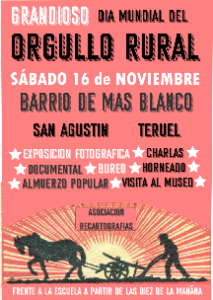
During the 2019 European Rural Parliament, many initiatives were presented and discussed, such as the Universal Day of Rural Pride.
What is the Universal Day of Rural Pride?

This day was recently celebrated for the first time on 16 November 2019. It is an initiative from the Spanish Plataforma ciudadana rural Mineras, a civil society platform in the county Cuencas Mineras. Here, most of the 43 villages have less than 200 inhabitants, and the present closure of the coal mines and coal power plants is deeply affecting the inhabitants.
Aiming to break free from the negative stereotypes rural inhabitants suffer from – and show all the benefits and opportunities in rural areas – the Plataforma ciudadana rural Mineras chose to dedicate a day specifically on this: The Universal Day of Rural Pride.
As many Spanish regions are confronted with similar issues as the Cuencas Mineras county, quickly more associations – like Recartografías in San Agustín – joined in to help improve the self-esteem of rural inhabitants.
Being proud: breaking free from negative stereotypes and revaluing rural areas
Rural inhabitants suffer from many negative stereotypes. For example, that they are uneducated and close-minded. Or live in rural areas because they lack career prospects in the city. Or that there are no modern comforts in rural areas. Confronted daily with such stereotypes can make rural inhabitants feel inferior to urban inhabitants. This feeling, unsurprisingly, is one of the (many) factors driving people away from the rural areas.
So, special effort is made to get rid of these stereotypes and revalue rural areas. For instance, the mayor of San Agustín – one of the places where the Rural Pride day was celebrated – explained:
“Nowadays people living in rural areas live there because they want to. They have a strong bond with the territory, its people, nature, and heritage, and make a conscious choice to not give it up for whatever urban areas might have to offer. Positive aspects of rural areas are the high quality of life, contact with nature, strong social bonds, and an incredible variety of cultural, historic, gastronomic, architectonic, natural, and industrial heritage.”
Next step: Universal Day of Rural Pride across Europe
Instead of focussing on all that is wrong in rural areas and blaming others for it, the Rural Pride day celebrated last November in Spain shows how to put rural areas in a positive light and celebrate the great things these areas have.
Making rural communities feel proud of their territory being crucial for the development of rural areas, Euromontana welcomes the initiative. The Universal Day of Rural Pride should participate in highlighting the differences and similarities between rural regions and to counterbalance negative framing. Organised nearly one month before the International Day of Mountains, on December the 11th, the period could be an opportunity to put a focus on rural mountain areas for a few weeks, to raise awareness on what they have to offer and to draw political attention to their specific needs.
So, will you join in and participate with the 2020 edition of the Universal Day of Rural Pride in your mountain area?
21 January 2020


