



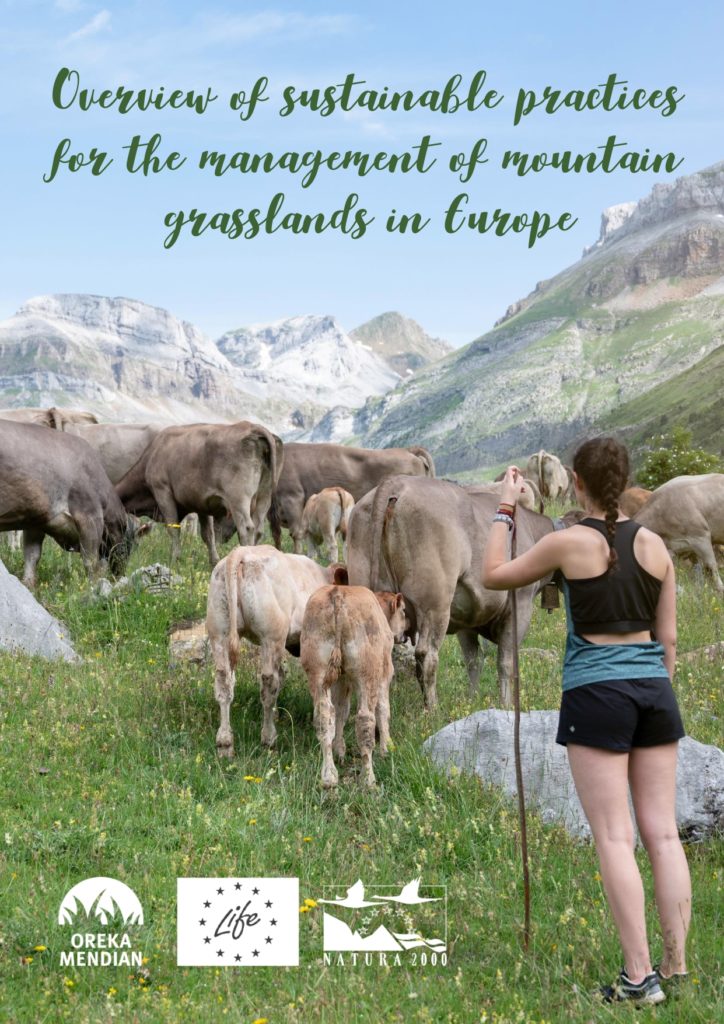
 In October 2021, the EU LIFE project OREKA MENDIAN published its final report “An overview of sustainable practices for the management of mountain grasslands in Europe”. Opened by Herbert Dorfmann, Member of the European Parliament, the report investigates the current state of mountain grasslands throughout Europe and provides a set of practices and recommendations that can ensure the environmental, economic, and social sustainability of this habitat.
What does the report include?
- A precise picture of what mountain grasslands represent in Europe in 2021 and its main challenges.
- An analysis of the most relevant policies linked to the management of mountain grasslands at the European level and in some European countries.
- 17 recommendations to support both the continuation of good practices on site, and their transferability to other places. These recommendations are based on the state of play of mountain grasslands, on discussions with experts and practitioners and on the 31 good practices collected by the project and published in a separate booklet (available in English, French and Spanish).
What are the key messages?
- Today, more than 75% of the grassland area in the EU-28 is considered to have an unfavourable conservation status. The current challenges to mountain grasslands include changes in the environment, unsustainable practices, and socio-economic changes.
- The good practices collected show the diversity of possible actions that can be carried out, at all scales (from local to transboundary), in different mountain regions (from the Scandinavian mountains to the Balkans) and on a wide range of topics (from biodiversity conservation to enhancing rural-urban linkages), and through all sorts of financing mechanisms (from publicly funded projects to private companies).
- The implementation of practices depends largely on the support and efficiency of policy frameworks. This report argues that, so far, both national and European political efforts have been unable to completely prevent the drastic decline of mountain grasslands and pastoral practices.
- The EU-27 needs a more ambitious vision for rural and mountainous areas at all scales, envisaging an EU Action Plan for pastoralism. Moreover, within the 2021-2027 period, Member States should also design CAP eco-schemes that support the sustainable management of mountain grasslands and recognise the ecosystem services provided by pastoralism. As detailed in the report’s recommendations, more efforts should also be deployed at all scales to better promote and market mountain products and raise awareness on the different benefits arising from their production.
You can download the full report in English, French and Spanish.
6 October 2021


