



Presentation of paper: “Understanding the relevance of the Biosphere Reserve concept for the provision of public goods in the mountain region of Lungau, Austria”
At conference: “International Conference on Research for Sustainable Development in Mountain Regions”; Ecosystem services and sustainable development
5-7 October 2016, in Bragança, Portugal
by Thomas Dax, Ingrid Machold and Thilo Nigmann
The International Conference on Research for Sustainable Development in Mountain regions provided an excellent opportunity to present the research objectives and first interim findings from the EU-project PEGASUS (Public Ecosystem Goods and Services from land management – Unlocking the Synergies). During Symposium 21, which was focused on analyzing the theme “Moving toward sustainable mountain socio-ecological systems: the challenge and promise of cross-level governance”, Austrian project partner (Thomas Dax, BABF) presented the main conceptual ideas of the PEGASUS project and referred to a specific case study in the mountainous area of Austria.
 The PEGASUS project is a European research project that aims to develop innovative approaches and new ways of thinking about the way farmland and forests are managed in order to stimulate a long-lasting improvement in the provision of public goods and ecosystem services from agricultural and forest land in the EU. The presentation underscored the deep interest among EU decision-makers and stakeholders in elaborating processes that sustain environmentally and socially beneficial outcomes (ESBOs) from agriculture and forestry, two sectors that are usually under-valued in conventional markets and rural areas. While demand for public goods from forestry and agriculture is widespread, the challenge for the PEGASUS project is to conceptually understand how these goods are being provided through a set of complex interlinkages, internal and external drivers, and institutional arrangements. The complex interplay of human action with natural production processes that shape the specific bundles of goods and services provided from each region is studied in the project by using Social-Ecological Systems theory.
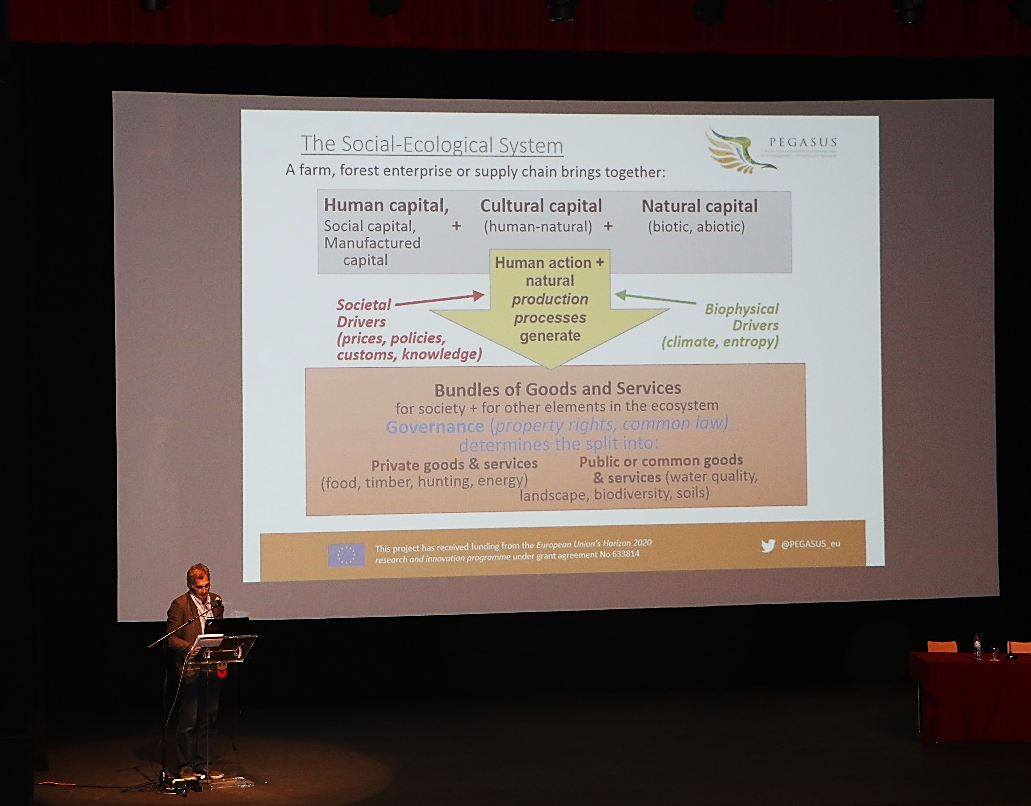 The presentation of results from the Lungau mountainous area, which is part of the most recently approved Biosphere Reserve in Austria, showed how the project works at the level of a specific case study. In particular, the presentation emphasized that the main public goods in the case study are those that are very important in mountain regions. These include biodiversity, protection of the specific Alpine cultural landscapes and securing an active and socially resilient rural community (“rural vitality”).
Several primary indicators were presented to show that the Biosphere reserve has effects in the region in terms of land use (a very high share of organic farmers, about 50%), nature conservation measures and demographic development (e.g. positive external migration balance over last years).
It was also underpinned that the regional development of land use is highly dependent on public support (through the Rural Development Programme) which has significant effects in mountain areas. With regard to land use it seems particularly important to monitor intensification trends in grassland use and conversion between agricultural and forest land use.
As tourism is one of the sectors with the most potential for job development, a thorough investigation of the various dimensions of ‘sustainable development’ is important if the high-quality goals of Biosphere reserves are to be achieved.
Analysis of the start phase of implementation shows that raising awareness and enhancing local participation processes is crucial for initializing changes towards more sustainable pathways in the mountain context of this specific case study.
25 October 2016


