



On Wednesday 28 June 2017, Euromontana’s members of the working group on mountain products met in Paris. During the first part of the meeting, Alice Dos Santos, our former intern, presented the conclusions of her master thesis on the labelling of mountain products.
 Her study sought to better understand the links between the labelling of mountain products, their valorisation and territorial development. To do so, she studied the territorial embeddedness, the governance, and the marketing strategy of different quality schemes established within mountain territories: the French PDO Comté, the Eusko Label from the Spanish Basque government and the brand Pro Montagna from the Swiss Coop supermarkets.
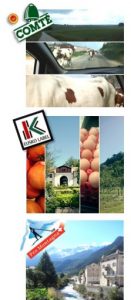 If she noted that the image of the mountain is present in the three initiatives, only Pro Montagna based its marketing strategy on the “mountain” dimension. For the PDO Comté, it is the dimension “PDO-product of terroir” which is the strongest and for Eusko Label it is the dimension “regional product”. The territorial embedding of the PDO Comté is very strong, all the actors of the sector are collectively involved in the decision-making at the level of the Interprofessional Management Committee of the Comté (in French Comité Interprofessionnel de Gestion du Comté). As for the Eusko Label, it is managed by the Basque government and its HAZI foundation although the actors involved in the different value chains are closely consulted in the decision-making. Finally, for Pro Montagna, it is Coop who takes all the decisions. The relationship between Coop and its producers appears to be essentially commercial.
In conclusion, Alice Dos Santos stressed that while the labelling of mountain products is a relevant marketing tool to convey information to consumers, it does not always bring added value to the farmers. For this to happen, it is essential that the interests of each actor are represented and that the value chain is collectively managed, so that the different stakeholders agree to implement together mechanisms for the redistribution of the added value. To make the best use of their valorisation tool, it is therefore crucial for actors to take ownership of it.
To learn more about this study you can access the presentation and the memory (thesis) by clicking on the hyperlinks.
3 July 2017


